Two Weeks in Japan: The Grand Tour from Tokyo to Fukuoka
The full-arc version of Japan: two weeks, seven stops, one straight line west. Start with Tokyo's temples and towers, cut across to Kanazawa for samurai lanes and Kenrokuen, dip into Kyoto and Nara for the classical heartland, eat your way through Osaka, then ride the Sanyo Shinkansen to Hiroshima's Peace Park and Miyajima before ending among Fukuoka's yatai food stalls. This guide gives the day-by-day rhythm, the transfer tricks (Thunderbird, JR rapids, the Miyajima ferry), a realistic budget for backpacker to comfort tiers, and the 14-day JR Pass math — which, point-to-point chain versus ¥80,000, comes out firmly against the pass.
Route: Tokyo Kanazawa Kyoto Nara Osaka Hiroshima Fukuoka
Two weeks lets you see Japan as a country rather than a checklist, and the smart shape is a single westward arc: Tokyo for the modern megacity, Kanazawa for samurai streets and one of Japan’s three great gardens, Kyoto and Nara for temples, Osaka for the food, Hiroshima for history and the sacred island of Miyajima, and Fukuoka for a laid-back finale of ramen and riverside food stalls. You never retrace a step, every transfer is a single seat, and you fly home from Fukuoka. Here is the day-by-day.
Day 1: Arrive in Tokyo
Land, take the airport express in, and keep the first evening vertical: a walk through the neon of Shinjuku or the lantern lanes of Omoide Yokocho, an early izakaya dinner, early sleep. Jet lag is the only enemy today. Get an IC card into your phone wallet on the way in — it works on every subway, tram and convenience store for the next two weeks.
Practical tip: Reserve your Day 4 shinkansen seats tonight on the SmartEX app (or at a ticket machine tomorrow); mid-morning departures fill first. See the trains and IC cards guide for setting it all up.
Day 2: Tokyo — Old and New
Morning at Senso-ji in Asakusa before the crowds, midday in the forest silence of Meiji Shrine’s approach, and the afternoon in Harajuku and Shibuya. After dark, take the free view from the Tokyo Metropolitan Government Building observatory, or pay for a timed sunset slot at a tower deck booked days ahead.
Practical tip: Tokyo rewards early starts more than any other city on this route — Senso-ji’s grounds are free and quiet at 7 a.m., mobbed by 10. Our Tokyo guide ranks which views are worth paying for.
Day 3: Tokyo — Markets and a Flex Day
A flex day with a food spine: sushi breakfast at Tsukiji Outer Market (most stalls run 5 a.m. to early afternoon; Sundays thin out badly), then whatever Tokyo means to you — teamLab’s digital art (book well ahead), the Imperial Palace gardens, or a half-day trip to Kamakura if you crave a first taste of temple towns before Kyoto.
Practical tip: Check Monday closures before you commit — many Tokyo museums close Mondays, which is why this itinerary keeps Tokyo flexible and museums out of the headline days.
Day 4: Shinkansen to Kanazawa
Ride the Hokuriku Shinkansen northwest: roughly 2.5 to 3 hours, about ¥14,500, through the Japan Sea snow country. Drop bags and spend the afternoon in Kenrokuen (¥320, open 7 a.m.-6 p.m. in season) and the adjacent castle park, then dinner in the Katamachi entertainment district.
Practical tip: The Right/Left exit matters: Kanazawa Station’s east side has the loop bus stop for Kenrokuen — ¥220 a ride. The bus also stops at Omicho Market for tomorrow, so scout the route tonight.
Day 5: Kanazawa — Samurai Lanes and Market Lunch
A walking day with zero tickets: morning among the preserved wooden facades of the Higashi Chaya teahouse district, a market lunch at Omicho (crab in winter, sea urchin in summer), then the mud-walled Nagamachi samurai quarter. Gold leaf ice cream is obligatory and ridiculous in equal measure.
Practical tip: Kanazawa’s sights close early — most temple and garden entry ends by 5 p.m. — so front-load the day. If it rains, swap in the 21st Century Museum of Contemporary Art, whose free zones alone justify the trip.
Day 6: Thunderbird to Kyoto
The JR Thunderbird limited express runs Kanazawa to Kyoto in a bit over two hours (roughly ¥7,000-7,500 reserved — confirm when booking). Afternoon: the Nishiki Market arc for a first read on Kyoto’s food culture, then walk the Gion lanes at lantern-lighting hour before dinner along Pontocho.
Practical tip: Nishiki’s hundred-plus stalls mostly open 10 a.m. to 6 p.m. and many close Wednesdays or Sundays — and eating while walking is genuinely frowned on here, so graze at the counter, not the lane. Details in our Kyoto guide.
Day 7: Kyoto East — Fushimi Inari and Higashiyama
At 7 a.m., the thousands of vermilion torii at Fushimi Inari belong to you; by 10 they belong to Instagram. The full summit loop takes 2-3 hours — turn around at the halfway viewpoint if the heat disagrees. Afternoon along the Higashiyama slopes to Kiyomizu-dera, evening in Gion.
Practical tip: Fushimi Inari is free and open 24 hours; there is no ticket to book, so the crowd strategy is purely a clock decision. Buses accept the same IC card you have been using since Tokyo.
Day 8: Kyoto West — Arashiyama and the Golden Pavilion
Morning in Arashiyama: the bamboo grove early (free, always open), the riverside willow streets, and Togetsukyo Bridge views. Cross town after lunch to Kinkaku-ji, the Golden Pavilion (¥500, open daily 9-5), and finish with zen stillness at Ryoan-ji’s rock garden next door.
Practical tip: Arashiyama’s grove is a 10-minute walk from the station and gets uncomfortably full by 10 a.m. — the Keifuku tram from Shijo is the scenic way in. More pacing ideas in our best time to visit guide.
Day 9: Nara, Then On to Osaka
Check out and forward your luggage to Osaka by takkyubin (front desks arrange it; next-day or same-day options). The JR Miyakoji rapid runs Kyoto to Nara in 45 minutes for ¥720. Give Nara the afternoon: Todai-ji’s Great Buddha, the deer of Nara Park bowing for crackers, the lanterns of Kasuga Taisha. Early evening, ride the last short hop into Osaka and check Dotonbori’s neon off the list.
Practical tip: JR covers Kyoto-Nara, but the Kintetsu line drops you closer to the park — either works; the JR pass question is moot since you are not buying one (see Practical Notes).
Day 10: Osaka — Castle, Markets, Neon
Osaka Castle’s park in the morning, then eat the city in order: Kuromon Market’s 150 stalls for a grazing lunch, retro Shinsekai for kushikatsu in the shadow of Tsutenkaku Tower, and Dotonbori after dark. If theme parks are your language, spend this day at Universal Studios Japan instead — but that needs its own booking strategy.
Practical tip: Kuromon runs roughly 8 a.m. to 6 p.m. with a fair number of Sunday closures; carry some cash since not every stall takes cards. Our Osaka guide covers where to base yourself.
Day 11: Shinkansen to Hiroshima
From Shin-Osaka, the Nozomi covers Hiroshima in about 90 minutes (roughly ¥10,000-11,000). Drop bags and give the afternoon its due gravity: the Peace Memorial Park, the A-Bomb Dome across the river, and the museum — a few hundred yen, and plan on two quiet hours.
Practical tip: The tram system is flat-fare ¥240 a ride from Hiroshima Station to the park — a ¥700 day pass pays off on the fourth ride. Keep the museum for after lunch; you will not want dinner reservations right after.
Day 12: Miyajima Day Trip
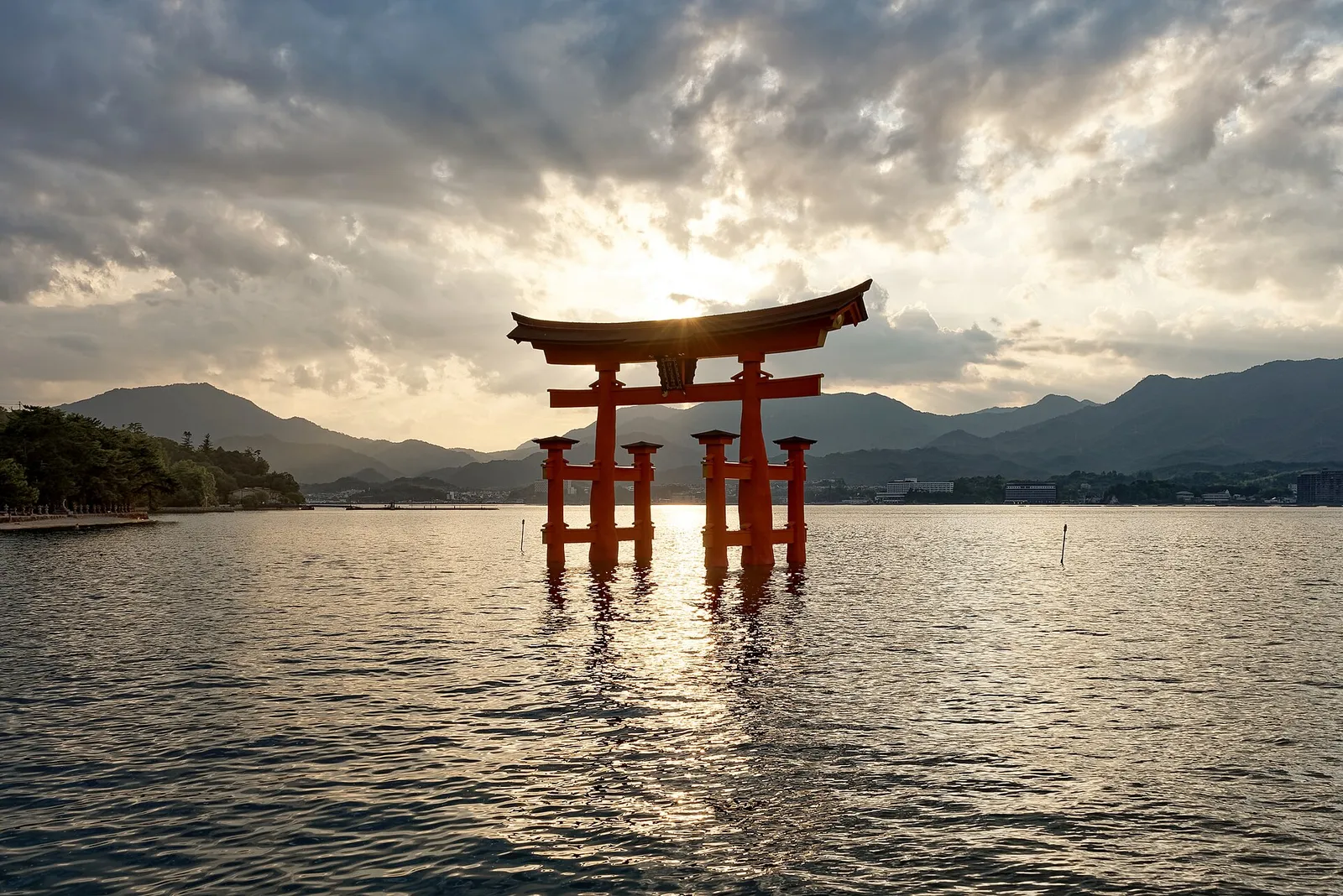
Twenty-five minutes on the JR Sanyo line to Miyajimaguchi, then the 10-minute ferry (¥200 plus the island’s ¥100 visitor tax). Time your visit to the tide chart: the great floating torii of Itsukushima Shrine is genuinely in the sea at high tide and beached at low. Hike or ropeway up Mount Misen if the weather holds; back in Hiroshima, order the okonomiyaki — this is its hometown.
Practical tip: Most visitors day-trip and the island empties beautifully after the last ferries — if your budget allows, an overnight on Miyajima is one of the route’s best upgrades. Ferry and tide details live in our Hiroshima guide.
Day 13: Hiroshima to Fukuoka, Evening at the Yatai
The final shinkansen hop: Hiroshima to Hakata in about 70 minutes (roughly ¥9,000-9,500). Softer plans for the afternoon — Ohori Park’s lake loop, the canal-side Canal City complex — because the evening is the point: Fukuoka’s open-air yatai stalls. The row along Nakasu Island packs about 20 of them, red-lantern lit from around 6 p.m.
Practical tip: Each stall seats seven or eight, one group at a time; join the queue, order a drink and something grilled, and bring cash. Stalls close one day a week each and shut in heavy rain — have a ramen shop backup.
Day 14: Dazaifu, Then Fly Home from Fukuoka
If your flight leaves in the evening, spend the morning in Dazaifu: a Nishitetsu train from Tenjin to the plum-tree approach of Dazaifu Tenmangu, shrine of learning, with the Kyushu National Museum next door for the flight-window finale. Fukuoka Airport is a five-minute subway ride from Hakata Station — the easiest airport exit of any big Japanese city.
Practical tip: Confirm your airline’s airport terminal tonight; Fukuoka’s international and domestic terminals are a short free bus apart, and the subway reaches both. Luggage forwarded from Osaka should already be waiting.
Practical Notes
Intercity transport
| Leg | Mode | Time | One-way cost (approx.) |
|---|---|---|---|
| Tokyo → Kanazawa | Hokuriku Shinkansen | 2.5-3 h | ~¥14,500 |
| Kanazawa → Kyoto | JR Thunderbird Ltd Exp | ~2 h + | ~¥7,000-7,500 |
| Kyoto → Nara | JR Miyakoji rapid | 45 min | ¥720 |
| Nara → Osaka | JR / Kintetsu | ~40-50 min | ~¥700-820 |
| Shin-Osaka → Hiroshima | Nozomi shinkansen | ~90 min | ~¥10,000-11,000 |
| Hiroshima → Hakata | Nozomi shinkansen | ~70 min | ~¥9,000-9,500 |
Fares as of October 2026; Sanyo-leg figures are rounded estimates — verify on SmartEX or the JR West site when booking. City transport is IC card territory everywhere (trains and IC cards).
Budget estimate (per person, excluding international flights)
- Backpacker: US$1,400-1,900 — hostels, market and konbini food, all intercity rail in reserved seats
- Mid-range: US$2,200-3,000 — 3-4-star hotels, one ryokan night, mixed casual and fine dining
- Comfort: US$3,800-5,500 — design hotels, Green Car on long legs, kaiseki in Kyoto, a Miyajima overnight
Flights home from Fukuoka often price similarly to Tokyo returns — check both before committing to the one-way arc.
JR Pass verdict
The 14-day pass (¥80,000 as of October 2026) loses on this route. The full one-way chain above totals roughly ¥42,000-46,000 in point-to-point tickets; even adding a Hakata-Tokyo return shinkansen (about ¥23,000) keeps you under pass price at around ¥65,000-69,000. The JR Pass guide explains when the math flips — heavy loops and side trips, mostly. Run your exact plan through the JR Pass calculator, but for the Tokyo-to-Fukuoka arc: buy point-to-point, book each leg a day or two ahead, and put the savings toward the Miyajima overnight.
Sources & verification (13)
- https://www.japan-guide.com/e/e2361.html
- https://www.japan-guide.com/e/e4208.html
- https://www.japan-guide.com/e/e4200.html
- https://www.japan-guide.com/e/e2363.html
- https://www.japan-guide.com/e/e3915.html
- https://www.japan-guide.com/e/e3908.html
- https://www.japan-guide.com/e/e4107.html
- https://www.japan-guide.com/e/e3404.html
- https://www.japan-guide.com/e/e3454.html
- https://www.japan-guide.com/e/e4802.html
- https://www.japan-guide.com/e/e4803.html
- https://www.japan-guide.com/e/e4850.html
- https://www.japan-guide.com/e/e4001.html