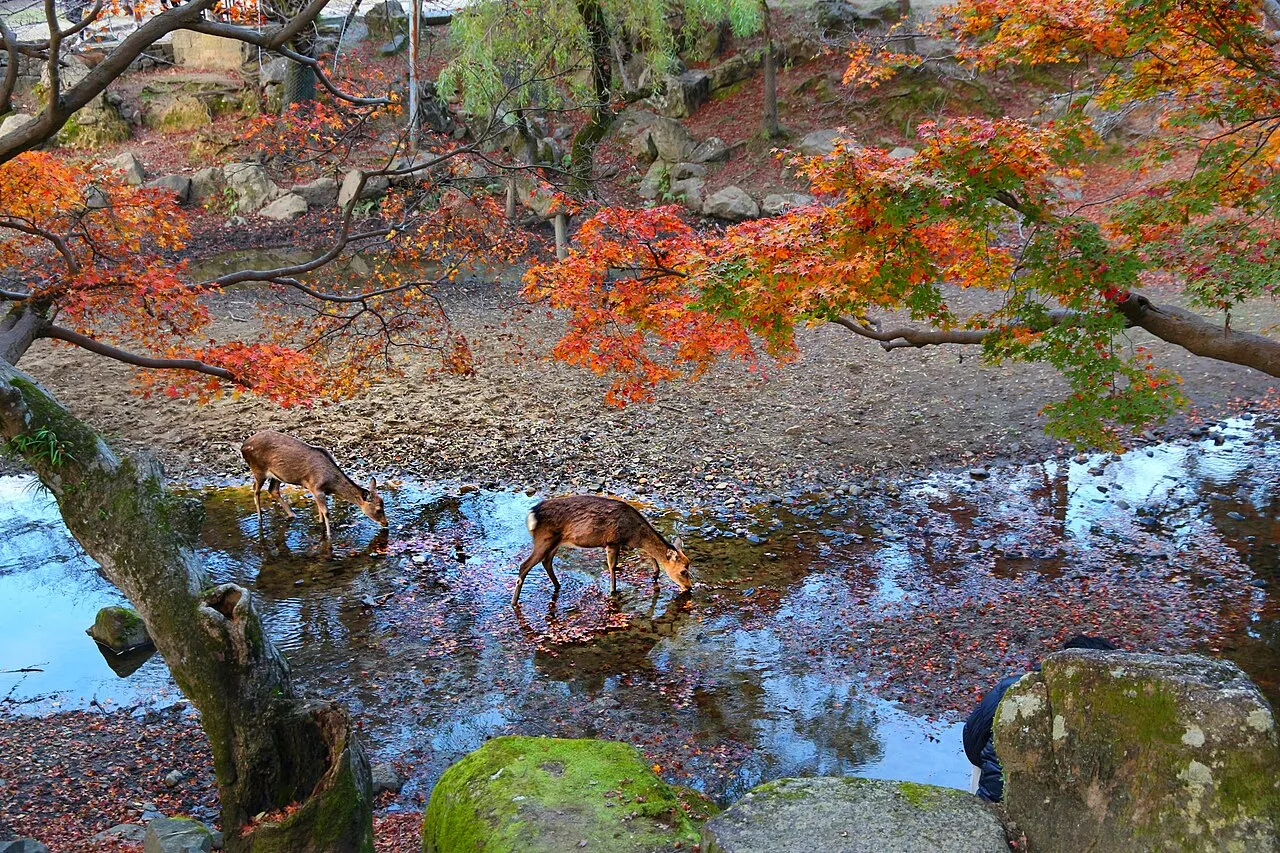
Nara was Japan's first permanent capital, founded in 710, and it keeps the country's oldest and biggest statements: the Great Buddha of Todai-ji inside what was long the world's largest wooden building, a grand Shinto shrine approached through thousands of lanterns, and a huge central park where more than a thousand sacred deer roam free and bow for crackers. Everything worth seeing sits inside or beside that park, walkable from the train stations, which makes Nara an easy and near-perfect day trip from Kyoto or Osaka. It rewards an overnight stay even more — the day-trippers leave at five, and the lantern-lit park is yours. Best for first-timers doing the Kansai circuit, families, and anyone who wants ancient Japan at a small-town pace.
Top sights at a glance
No. 1
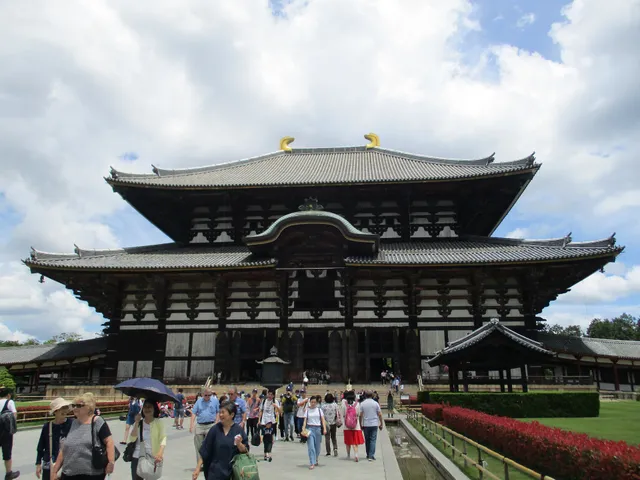
Todai-ji Temple
The head temple established in 752 to anchor state Buddhism, built around a bronze Great Buddha nearly 15 meters tall — his open palm alone is human-sized. The Daibutsuden hall that houses him, rebuilt in 1692 at two-thirds the original scale, still ranks among the world's largest wooden buildings, which is the most efficient history lesson in Japan: the original was titanic. Kids queue to squeeze through a hole in a hall pillar the size of the Buddha's nostril, said to grant enlightenment to those who fit. The Nandaimon gate's guardian statues are national treasures carved in the 1200s.
Good to know · The Daibutsuden costs ¥800 (¥1,200 combined with the museum); hours are 7:30-17:30 April-October and 8:00-17:00 November-March, open daily, as of October 2026. Go at opening — tour buses arrive mid-morning — and enter through Nandaimon gate. From Kintetsu Nara Station it is a 20-minute walk through Nara Park; from JR Nara, 30-35 minutes or a short bus ride.
No. 2
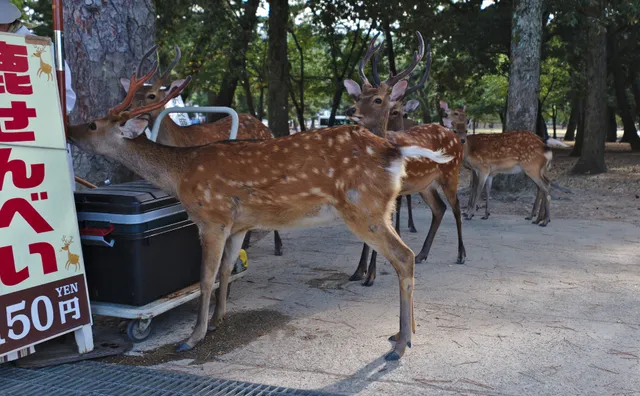
Deer of Nara Park
Some 1,200 deer — a protected natural monument — roam free across Nara Park and the temple grounds, and they are the city's co-citizens: legend says a deity arrived riding a white deer, and the animals have been treated as divine messengers ever since. Many have learned to bow for crackers, and the bow-back-and-feed exchange is the single most-delivered travel memory in Japan. They are wild animals, not pets: feeding them anything but official crackers is prohibited, and bucks in autumn rut and does with fawns deserve extra distance.
Good to know · The park is free and always open; official deer crackers (shika senbei) cost about ¥200 a stack at stalls around the park — buy before the deer notice you. Hold the cracker flat, bow, let them bow, hand it over, then show empty hands. Do not dangle food, tease, or leave paper items unattended; deer eat maps. Help is a wave away: 「すみません」 (sumimasen) and a smile at any stallkeeper.
No. 3
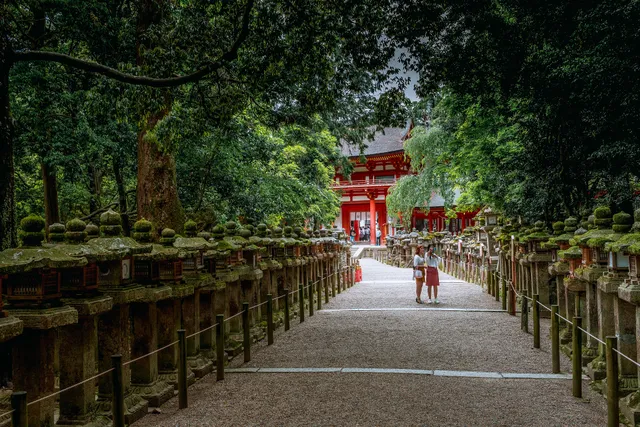
Kasuga Taisha
Nara's grand Shinto shrine, established by the powerful Fujiwara family in the 700s to protect the new capital, and famous for lanterns: hundreds of bronze ones hanging from vermilion eaves and thousands of mossy stone ones lining the forest approaches — donated across a millennium by everyone from aristocrats to trade guilds. They are lit only twice a year, early February and mid-August, when the whole shrine glows at night. The deeper approach cuts through Kasugayama, a primeval forest untouched by axes for over a millennium and itself a UNESCO World Heritage site.
Good to know · Grounds free and open dawn to dusk (6:30-17:30 March-October, 7:00-17:00 November-February); the paid inner sanctuary, ¥700, is open 9:00-16:00, as of October 2026. It is a beautiful 30-minute walk from Kintetsu Nara through the park and forest, or a ¥250 bus to the Kasuga Taisha Honden stop. Aim for the lantern-lit festivals if your dates align.
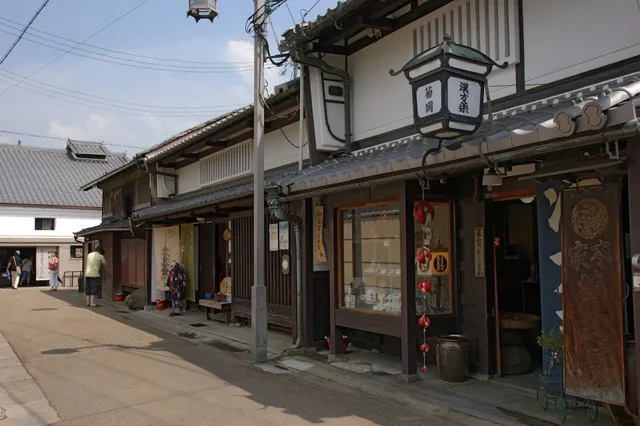
No. 4
Naramachi
The old merchant quarter, grown on the former grounds of Gango-ji — one of Japan's seven great Nara-era temples — after the capital moved away and the town had to trade to survive. Its lanes of machiya townhouses (narrow frontage, long interior — a tax dodge that shaped the architecture) now hold cafes, small craft shops, sake bars, and a few museums. The free Koshi-no-ie residence shows how a merchant family actually lived, shop front and home behind it, and scattered Gango-ji halls survive between the lanes, quiet and easy to have to yourself.
Good to know · Streets free and open around the clock; Koshi-no-ie (latticework house) is free, 9:00-17:00, closed Mondays and around New Year, as of October 2026. Gango-ji costs ¥500, 9:00-17:00. The district is 10-15 minutes' walk south of Kintetsu Nara Station — make it your lunch stop and gift-shopping lap on the walk between station and park.
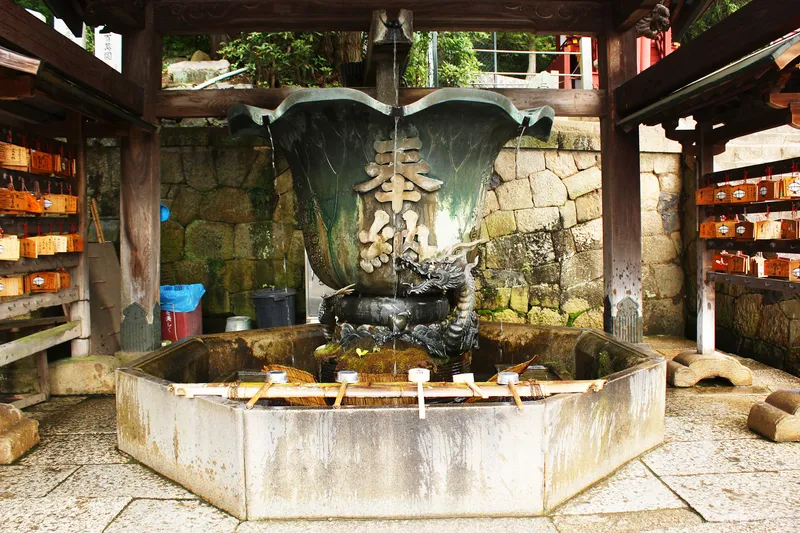
No. 5
Nigatsu-do
The 'Hall of the Second Month,' a Todai-ji sub-temple on a hillside east of the Great Buddha Hall, and Nara's best free view: a broad wooden stage hanging over the town with the Nara plain spreading to the mountains. No ticket, no closing time, and benches to sit on — which is why locals treat it as a living room and visitors in the know climb it for sunset. Each March it stages Omizutori, a 1,200-year-old fire ceremony in which monks wave giant torches from the stage's railings to light the way for spring; embers are said to bless those below.
Good to know · Free and always open — go at dusk, and come back at night when the stage and valley are lamplit. It is a five-minute uphill walk from the Daibutsuden, so pair it directly: Buddha first, then this. During Omizutori (early to mid-March) expect dense crowds and arrive hours early for the big torch nights; on ordinary evenings it is near-empty.
See it in motion
Some places earn a moving picture
Stills can't show how this place moves — the drift, the light show, the crowd flow. We picked a recent, high-quality walkthrough rather than a promotional cut.
Nara, JAPAN - The Magical Deer City of Japan, Nara Park & Todai-ji 4K Walking Tour
Walking Expedition · YouTube · plays on click
Embedded via YouTube's official player (privacy-enhanced mode). Video: Nara, JAPAN - The Magical Deer City of Japan, Nara Park & Todai-ji 4K Walking Tour by Walking Expedition. Not affiliated with Japan Travel Navi; screened for quality and accuracy on 2026-10-06.
Nara is the quiet superlative of Japan travel: the first permanent capital (710), the largest bronze Buddha in a country full of them, one of the world’s biggest wooden buildings, and a city park where more than a thousand sacred deer bow for crackers. All of it sits within a walkable bowl of parkland and forest, an hour or less from both Kyoto and Osaka — which is why most people see it as a day trip, arrive at eleven, and leave at four. That works. But Nara changes character completely when the day-trippers board their trains: the park goes amber and empty, lanterns come on, and the temples you shared with two hundred schoolchildren become yours. Come for the afternoon; better, stay for that evening.
A Bit of History
Before 710, Japan’s capital moved with each new emperor — a custom that kept the throne ritually pure and the bureaucracy permanently packing. Empress Genmei ended the moving by founding a permanent capital at Heijo-kyo, today’s Nara, laid out on the Chinese grid model like its successor Kyoto, with a population that may have reached 100,000 at its peak, enormous for the era. The Nara period (710-784) that followed was Japan’s first great cultural flowering: the first permanent Buddhist temples at national scale, the earliest surviving Japanese literature and chronicles, and the roots of the writing system itself.
The temple at the center of it was Todai-ji, “Great Eastern Temple,” commissioned by Emperor Shomu in the 740s as the headquarters of a network of provincial monasteries. Its Great Buddha was dedicated in 752 in a ceremony attended by thousands of monks, and casting it consumed much of the nation’s bronze. The project worked politically — Buddhism became a state-binding ideology — and then worked too well: the great temples grew into landholding powers whose meddling in politics spooked the court, and in 784 the capital moved first to Nagaoka, then to Kyoto in 794, largely to get away from the monks. One relic of that cosmopolitan court survives in place: the Shosoin repository at Todai-ji still holds eighth-century imperial treasures — Tang Chinese instruments, Persian glass, silks — opened each autumn for a famous exhibition.
Nara spent the next millennium as a temple town, sustained by pilgrims and by the merchants of what is now Naramachi. Its monuments aged into pilgrimage legends — the deer of Kasuga, the unbroken forest behind it — and escaped both the civil wars that scarred other regions and the wartime bombing that destroyed most Japanese cities. When UNESCO listed the “Historic Monuments of Ancient Nara” in 1998, eight sites went on the list at once, including Todai-ji, Kofuku-ji, Kasuga Taisha, Gango-ji, and the Kasugayama primeval forest. Today Nara is a modest city of around 360,000 people with an outsized share of the country’s founding architecture — the oldest things in Japan are disproportionately here.
Culture & Daily Life
The deer organize daily life more than any timetable. They cross roads at will (traffic yields), nap on lawns, investigate shopping bags, and gather at cracker stalls like regulars. The etiquette is simple and worth following exactly: feed only the official crackers sold at park stalls, hand-feed with a flat palm, and when a deer bows to you, bow back — then show your empty hands so it moves on. Never tease with food, and give antlered bucks a wide berth in autumn. Maps and paper are deer snacks; guard them.
Nara’s own pace is small-town Kansai: friendlier and chattier than Kyoto, slower than Osaka, with a food culture built on preserving and curing — pickles, cured fish, tea — rather than street spectacle. The old lanes of Naramachi set the tone: machiya cafes, craft knife and calligraphy shops, sake breweries with tasting counters. Shops close early by big-city standards; plan sightseeing for daylight and dinner before 20:00, when most of the restaurant town winds down.
At the shrines, the routine is the same nationwide — bow at the torii, rinse hands at the water fountain, coin, two bows, two claps, one bow — and our page at /guides/etiquette-manners/ covers the rest. Nara’s craftsmen, meanwhile, keep uncommon trades alive: calligraphy brushes (a nationally designated traditional craft here), sumi ink, and blade-sharpening; a brush with your name carved on the handle is one souvenir that gets used daily. And for a deer-free hour, the Nara National Museum at the park’s edge holds one of the world’s great collections of Buddhist art — the town’s best rainy-hour.
One ceremonial calendar note: each March, the Omizutori fire rites at Nigatsu-do (below) have announced spring for twelve centuries, drawing big evening crowds; in early February and mid-August, the lanterns of Kasuga Taisha are all lit at once for the only times all year. If your dates can bend toward one of these, bend them.
Nature & Day Trips
Nara Park is one of Japan’s great city parks — hundreds of hectares of lawns and forest at the foot of the hills, with the temples scattered through it, all free to walk. Behind Kasuga Taisha rises Kasugayama, a primeval forest preserved by shrine taboo from cutting for over a thousand years and now a UNESCO natural site; walking its outer paths is as close as most visitors get to eighth-century Japan. For a panorama, climb the grassy slope of Mount Wakakusa at the park’s eastern edge — its late-January controlled grass burning is a famous local spectacle — for a view over the whole city plain. Summers here are thick and still; the forest paths stay cool.
Day trips by train: Horyu-ji, about 30 minutes south, holds the world’s oldest surviving wooden buildings, raised around 670; the temple trio of Yakushi-ji and Toshodai-ji sits near it in the old capital’s southwest quarter. Asuka, the pre-Nara heartland of early Japan, is a pleasant rural cycling destination. Yoshino, the cherry-blossom legend on the ridge south, is a 90-minute ride and a pilgrimage of its own. And of course Kyoto, Osaka, and Kobe all sit within an hour in the other direction — most travelers day-trip into Nara, not out of it.
Food & Drink
Nara’s table is old-fashioned in the best sense — preservation foods and temple traditions. Start with kakinoha-zushi, mackerel or salmon pressed over rice and wrapped in a persimmon leaf, born as traveling food centuries before refrigeration: lightly vinegared, clean, and sold everywhere in beautiful boxes (¥800-1,500 for a small set). Narazuke are the local pickles — melon and daikon cured in sake lees for years — sold by weight in Naramachi shops that have cured them for generations. Chagayu, tea-flavored rice porridge, is the old Nara breakfast; a few restaurants serve it in traditional sets at lunch.
Miwa somen, from the shrine town just south, is among Japan’s oldest styles of noodle — hand-stretched wheat threads served cold with dipping sauce, ideal in summer. Kudzu-mochi, jellied arrowroot cakes served cool with dark sugar syrup, is the classic Nara sweet, and a teishoku set lunch — soup, pickles, rice, and a main — typically lands under ¥1,500. Nara is also quiet sake country: the prefecture grows the rice and pours the results at Naramachi brewery counters, where a three-cup tasting runs ¥500-1,000. Yamato beef and game dishes appear on colder-season menus.
Practically: most eating happens in the Naramachi lanes and the streets between the stations and the park, at a relaxed ¥1,000-2,000 per person for lunch and ¥3,000-5,000 for dinner with drinks. Cafes occupy the prettiest machiya; pick by queue length. Nara’s confectioners make wagashi sweets shaped like deer and lanterns, and a tea-and-sweet stop (¥600-1,000) is the standard afternoon pause. Two rules of thumb: carry some cash for the old lanes, where pickle shops and cracker stalls often skip cards, and eat dinner earlier than instinct — good kitchens here take last orders soon after 19:00 on quiet days. The visitor center near the park offers seasonal menus in English, and the printable cards at /cards/ cover allergies, checks, and directions.
Top Sights
Todai-ji Temple
Come for scale and stay for the details. The Daibutsuden’s columns and beams — rebuilt in 1692 at two-thirds the original footprint — still enclose a space that swallows tour groups whole, and at its center sits the bronze Vairocana Buddha, nearly 15 meters tall, flanked by two bodhisattvas. The statue’s story is national history: eighth-century Japan’s biggest industrial project, recast multiple times after earthquakes, its lotus petals engraved with Buddhist world-maps. Under the hall’s rear pillar, children (and flexible adults) attempt the nostril-hole squeeze; success predicts enlightenment in the next life, failure predicts a helpful monk pulling you back out.
The ¥800 ticket covers the hall (¥1,200 with the museum); hours are 7:30-17:30 April-October, 8:00-17:00 November-March, as of October 2026. Enter through the great south gate, Nandaimon, and look up at its two Nio guardian statues — carved in 1203 by the sculptor Unkei’s workshop, fierce enough to be a national treasure. From Kintetsu Nara, 20 minutes on foot through the park; buses stop closer. Time it for opening hour and you will hear the hall before you see it.
Deer of Nara Park
The deer are the park. More than a thousand of them — technically wild, officially a natural monument, spiritually the messengers of Kasuga’s deities — graze, nap, and commute across a couple of square kilometers of open parkland. The ritual that brings every visitor here is real and reliable: buy a stack of shika senbei crackers (about ¥200), hold one out, bow. A surprising number of deer bow back — a learned behavior, food-tested for generations — and the exchange never stops being delightful, for either party.
Respect keeps it that way. Feed only the official crackers (other food harms them and is prohibited), finish feeding by showing open hands, and don’t wave food you are not prepared to surrender — a teased deer is a headbutting deer. Keep small children at arm’s length from bucks, and know that a polite bowing deer can still nibble a sleeve. The park never closes, never charges, and is at its magical best at first light and dusk, when the crowds are gone and the deer reclaim the lawns.
Kasuga Taisha
Approach Kasuga the long way, through the forest, and the shrine assembles itself out of the woods: first the stone lanterns, thousands of them, mossy and leaning along the paths, donated across ten centuries by families and guilds; then the vermilion columns and cypress-bark roofs appearing between the cedars; then the inner halls, deep red, hung with bronze lanterns in ranks. Founded in 768 by the Fujiwara, the family that ran imperial politics for centuries, the shrine has been rebuilt on a 20-year cycle that keeps it perpetually new and perpetually eighth-century at once.
The grounds are free; the special inner sanctuary, an extraordinary hall of lanterns and vermilion lacquer, costs ¥700 (9:00-16:00), as of October 2026. Twice a year — early February and mid-August — all 3,000 lanterns, stone and bronze, are lit at once for the Mantoro festival, and the shrine runs on candlelight; if you can time a visit to one, do. From Kintetsu Nara it is a 30-minute walk through Nara Park and the forest approach (the good way), or the ¥250 bus to Kasuga Taisha Honden.
Naramachi
When the capital left, Nara’s economy did what merchant quarters do: it adapted. Naramachi — literally “Nara town” — grew along the edges of Gango-ji temple’s once-vast grounds, filling with machiya townhouses whose narrow street frontages (property tax was charged by access, not area) hide long interiors of workshops and homes. Today those lanes are the city’s most livable landscape: indigo dyers, knife shops, sake counters, and cafes in buildings with sagging tile roofs and lattice windows, all of it free to drift.
Two stops matter. The Koshi-no-ie residence, free and open 9:00-17:00 (closed Mondays and around New Year, as of October 2026), restores a merchant home with the shop up front and family quarters behind — ten quiet minutes that explain every other building you will see. And Gango-ji itself, ¥500, survives in fragments between the lanes: its main hall and pagoda were once part of a temple complex descended from Asuka-dera, considered Japan’s oldest temple, moved here in 718. Pick up kakinoha-zushi and narazuke pickles while you walk.
Nigatsu-do
Fifteen minutes uphill from the Great Buddha, Nigatsu-do is the view Nara keeps quiet about — a temple hall standing on its own wooden stage above the rooftops, facing the whole Nara basin. It belongs to Todai-ji, costs nothing, and never closes, which at dusk turns it into the town’s shared balcony: students on the steps, monks crossing behind the hall, the plain going gold then blue then lamplit. After dark the stage lights come on and the mood shifts to near-silence. Every Japan itinerary has one “just sit there” slot; in Nara, this is it.
The hall’s fame in Japan is ceremonial: since 752, the Shuni-e rites each March — popularly Omizutori — have sent monks out onto the stage’s balconies swinging torches as tall as trees, showers of embers falling on the crowd below as blessing, the fire ceremony that has literally announced spring in Japan for over 1,250 years. The big nights (March 12-14) draw tens of thousands and run late; any other evening you share the stage with a handful of people and the entire lit-up valley.
Getting There & Around
Two railways, two stations, one decision. From Kyoto: the JR Miyakoji rapid train takes 45 minutes and ¥720 (Japan Rail Pass valid), while the Kintetsu limited express does it in about 35 minutes for ¥1,280, or ¥760 on the hourly express — Kintetsu’s station sits closer to the park. From Osaka: Kintetsu runs direct from Namba in roughly 40 minutes. Trains run frequently; IC cards work everywhere.
Nara itself is a walking city: from Kintetsu Nara Station it is five minutes to the park edge, 20 to the Daibutsuden, 30 through the forest to Kasuga Taisha. Loop buses connect the stations with the sights (¥250 a ride; one-day bus passes ¥600-¥1,100 if you plan to ride repeatedly), and a Kintetsu Rail Pass (¥1,900 for one day, foreign passport holders) bundles trains and buses for wider exploring. Taxis exist and are barely needed. There is no airport in Nara — fly into Kansai or Osaka (Itami) and ride the trains in, under 90 minutes from either.
Where to Stay
Most visitors day-trip Nara, and that is a defensible choice — but the single best argument for one night is timing: overnighters get the park at dusk and Todai-ji at opening, the two hours day-trippers never see. If you stay, base yourself in or beside Naramachi, the old merchant quarter, where machiya guesthouses, small ryokan, and reservation-only restaurants cluster — atmospheric, walkable to everything, and quiet after dark.
The belt between Kintetsu Nara Station and the park holds most standard business hotels — functional, good value, five minutes from the deer. The JR Nara Station side, a 15-20 minute walk west of the park, is slightly cheaper and less convenient; pick it only for the price. Ryokan with kaiseki dinner sit in the hills around the park’s edges — book weeks ahead; some are an uphill taxi ride from either station.
Skip the overnight and base in Kyoto or Osaka instead — first trains land before 9 a.m., ahead of the buses, and an early start plus a Nigatsu-do sunset compresses Nara into one full day.