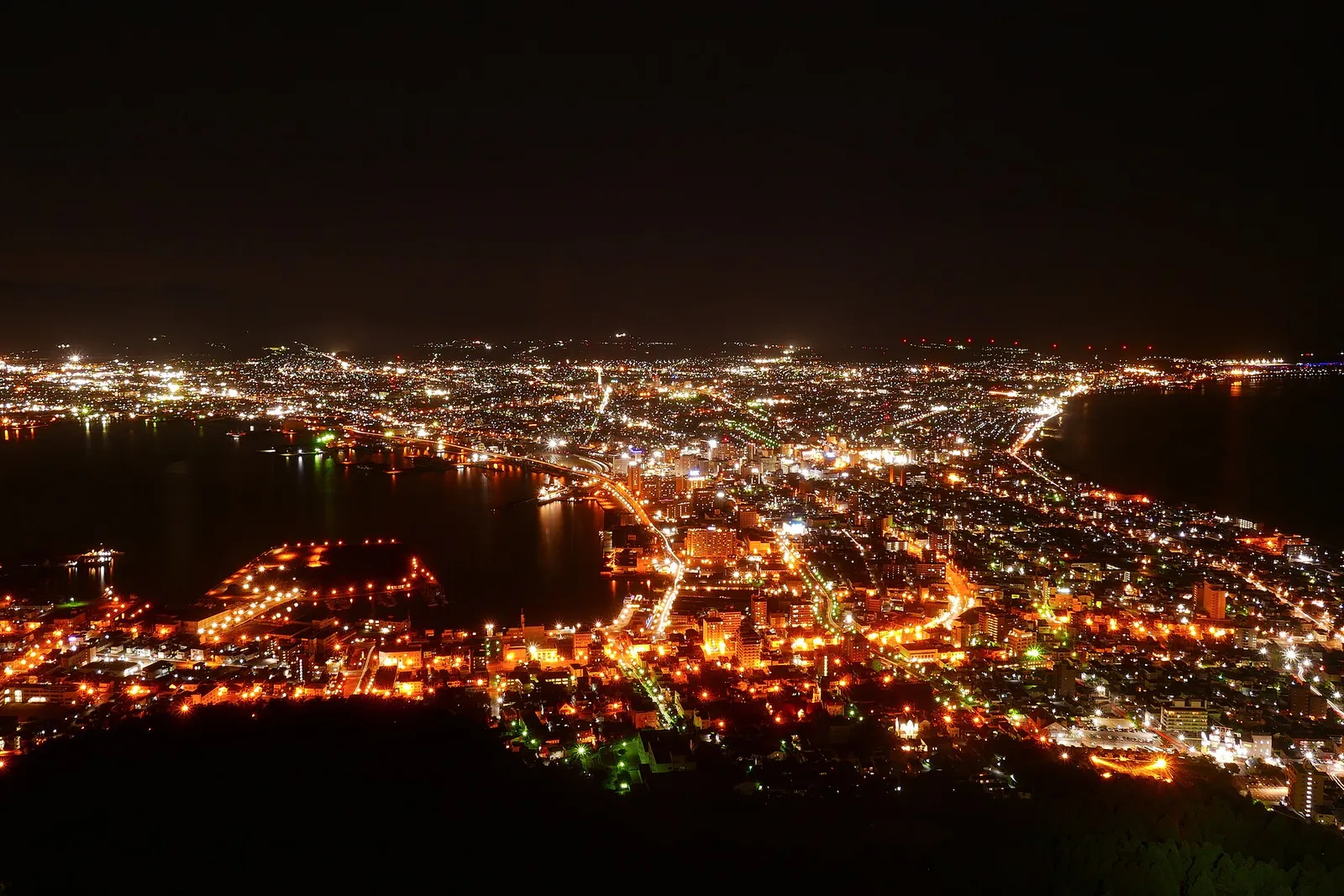
Hakodate is the southern gateway to Hokkaido and the island's most likeable city: a compact port that was one of the first in Japan opened to foreign trade, so churches and Western trading houses sit on its slopes next to a church-bell soundtrack. The headline is the view from 334-meter Mount Hakodate - the 'million-dollar night view' of a city strung across two bays - but the city earns its keep from breakfast onward: a morning market steps from the station where squid, crab, and sea urchin go over rice before 9 a.m. Add a star-shaped samurai fort, an onsen five minutes from the airport, and lakeside day trips, and Hakodate is the easiest two days in Hokkaido. Best for first-time Hokkaido visitors, couples, and eaters.
Top sights at a glance
No. 1
The Night View from Mount Hakodate
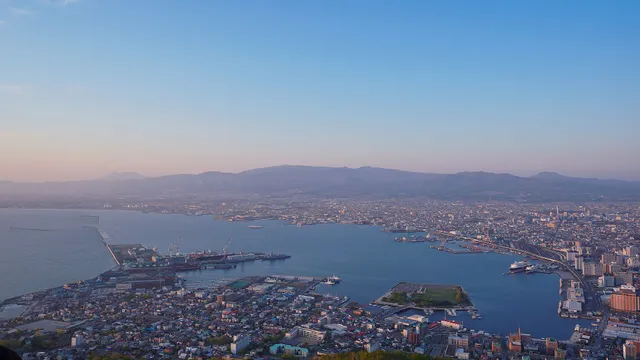
The 334-meter forested mountain at the tip of the peninsula does one thing and does it perfectly: because the city occupies a narrow strip between two bays, the summit view is a single fan of light shaped like a loop, with black water on both sides. It is ranked among Japan's three best night views alongside Mount Inasa in Nagasaki and Mount Rokko in Kobe, and on a clear winter night the sharpened air makes the case. Go up 30-40 minutes before sunset and watch the lights switch on rather than arriving to darkness.
Good to know · The ropeway round trip is 1,800 yen (1,200 one way), running every 15 minutes from 10:00 to 22:00, until 21:00 from October to mid-April, as of October 2026. Take tram 2 or 5 to Jujigai (210 yen) and walk 10 minutes. Note the ropeway's annual legal inspection closes it for about three weeks each late October to early November - in 2026 it runs October 20 to November 8 - and high wind suspends service, so check the operator's site before committing your evening.
No. 2
Hakodate Morning Market
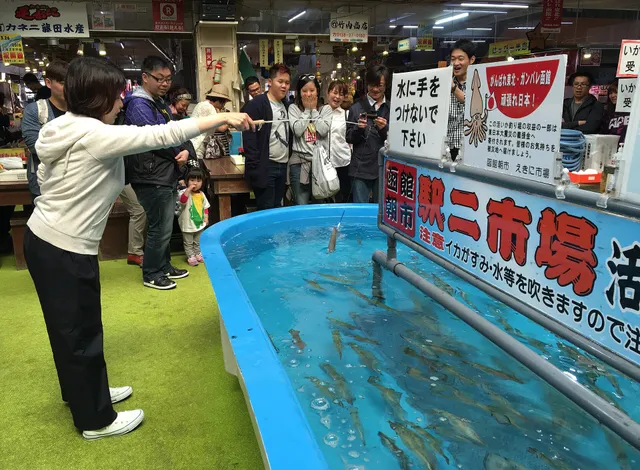
Four city blocks of crab tanks, melon pyramids, and counter restaurants immediately east of JR Hakodate Station - the reason to set an alarm in a city that otherwise runs at half speed. The classic breakfast is a seafood bowl: rice topped with uni, ikura, sweet shrimp, or crab, typically 2,000-4,000 yen depending on generosity. The local specialty is squid - in season, some counters serve it live, sliced seconds after catching, so transparent it is nearly invisible. March to May brings the 'squid fishing' stalls where you drop a hook into a tank and they cook what you catch.
Good to know · Open daily roughly 5:00-14:00 (from 6:00 January-April); go before 9:00 to eat with the traders rather than the tour groups. Walk straight out the station's east side; no ticket, no reservation. Prices soften in winter - crab is actually best and cheapest from November to March. Bring cash for the smaller stalls, and point or show 「イクラ丼をください」 for a salmon-roe bowl.
No. 3
The Motomachi District
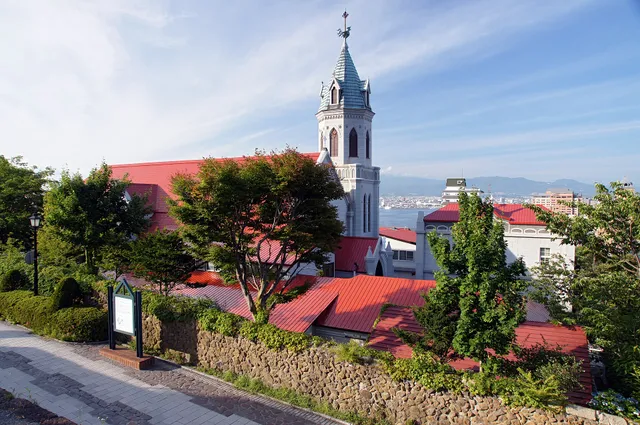
When Hakodate opened to foreign trade in the 1850s, the newcomers built their churches and consulates on the slopes at the foot of the mountain, and that district survives as the city's most atmospheric walk. Three churches face each other across the lanes - the Russian Orthodox Church with its onion domes, the Catholic Motomachi Church, and the Episcopal Christ Church - and the Old Public Hall, a 1910 wedding cake of pale blue and yellow, crowns the hill. The stone-paved slopes falling toward the bay, like Hachimanzaka, are the postcard shots.
Good to know · A 5-minute tram ride or 20-30 minute walk from Hakodate Station. The Old Public Hall charges 300 yen (9:00-18:00 April-October, to 17:00 in winter); the Russian Orthodox Church 200 yen, closed late December to mid-March. The churches are working parishes - quieter than sightseeing, so keep voices down. Climb any slope uphill and you end up at the ropeway's base station: Motomachi and the night view chain naturally into one evening.
No. 4
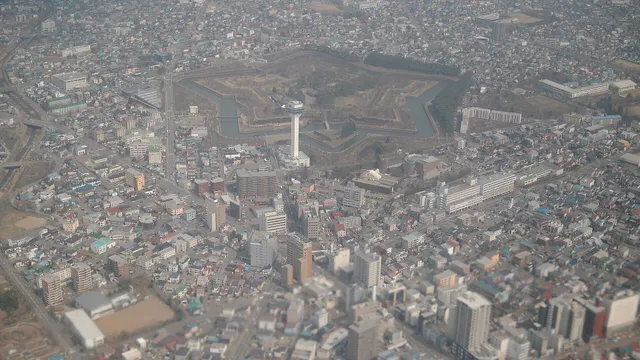
Goryokaku Fort
Japan's first Western-style fortress: a five-pointed star laid out from 1857 by Takeda Ayasaburo on Dutch models, built to defend the newly opened port against the very foreign powers it was trading with. Instead it became the last battlefield of the samurai - in 1868-69 the remnants of the shogun's army under Enomoto Takeaki holed up here against the new Meiji government's forces, and the fort's surrender in May 1869 ended the Boshin War and the feudal era with it. Today the moats are a public park planted with over a thousand cherry trees, spectacular in early May.
Good to know · The park is free; the 107-meter Goryokaku Tower above it (1,200 yen, 9:00-18:00, open daily) gives the view that makes the star legible - go to the 90-meter deck and photograph the full pentagon. Inside the fort, the reconstructed Former Magistrate's Office charges 500 yen (9:00-18:00, until 17:00 November-March, closed December 31-January 3). Take the tram 15 minutes to Goryokaku Koen-mae (230 yen) and walk 10 minutes. In blossom season locals barbecue under the trees; buy charcoal-grilled food at the stalls and join them.
No. 5
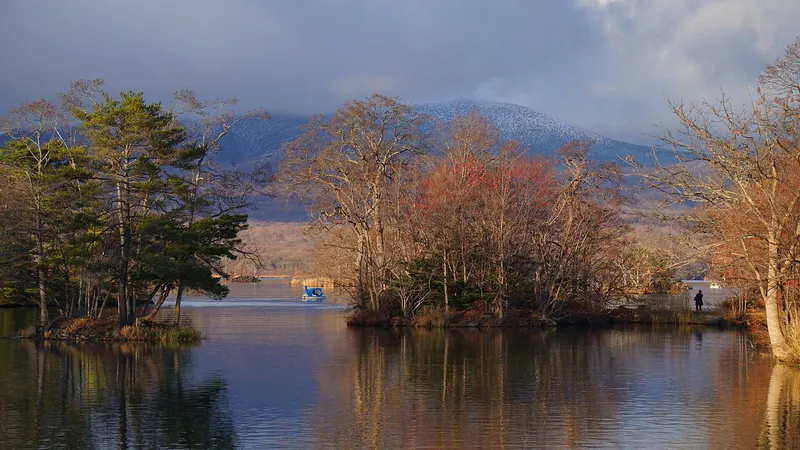
Onuma Quasi-National Park
Half an hour north of the city, the land flattens into a chain of lakes dotted with small islands - 26 of them in the main lake alone - under the smoking cone of Mount Komagatake, a volcano that erupted as recently as 2000. The prettiest corner, between Onuma and Konuma lakes, is walkable on a network of short trails and footbridges linking peninsulas and islets, each loop 15-60 minutes. It is the easy half-day of water, forest, and volcano that balances two days of city eating - and a natural stop en route to or from Sapporo.
Good to know · Trains from Hakodate reach Onuma Koen Station in 30 minutes by limited express (1,840 yen, reserved seats) or 40 minutes by local (680 yen); most expresses toward Sapporo stop there, so ask staff to stop you - it is a small request-side station. Sightseeing boats loop the lake every 40 minutes in the warmer months (about 30 minutes, 1,460 yen); rental bikes run about 500 yen per hour. Autumn color peaks late October to early November.
See it in motion
Some places earn a moving picture
Stills can't show how this place moves — the drift, the light show, the crowd flow. We picked a recent, high-quality walkthrough rather than a promotional cut.
Mt. Hakodate Ropeway ride + ambience / 4K60 HDR
Philip's Places · YouTube · plays on click
Embedded via YouTube's official player (privacy-enhanced mode). Video: Mt. Hakodate Ropeway ride + ambience / 4K60 HDR by Philip's Places. Not affiliated with Japan Travel Navi; screened for quality and accuracy on 2026-10-06.
Some cities take a day to explain themselves. Hakodate takes about ten minutes: stand at the water’s edge and the place reads like a map - a narrow, two-bayed peninsula strip where Japan’s first foreign traders built their churches, a mountain sitting at the end of it like a viewing platform, and a fish market parked next to the train station as if the city knew its own priorities. This was one of the three ports Japan was forced to open in the 1850s, and it still feels like the frontier where Edo-era Japan first touched the West - then ate a very good breakfast. Two days is the right dose: one for the night view and Motomachi’s slopes, one for the fort and the morning market, ideally with Sapporo or the tail of a Tohoku itinerary attached.
A Bit of History
For most of the Edo period, this was Matsumae, a small northern domain entrusted by the shogunate with trade with the indigenous Ainu - the rest of Hokkaido was outside Japan proper. Then Commodore Perry’s gunboats arrived in 1854, and the Treaty of Kanagawa opened two ports to American ships: Shimoda, and this one, then called Hakodate. When full trade treaties followed in 1858, Hakodate became one of the first three open ports alongside Yokohama and Nagasaki. Foreign consuls, merchants, and missionaries arrived and settled at the foot of the mountain in what is now Motomachi, raising the churches and trading houses that give the district its texture.
The shogunate’s response to being opened at gunpoint was to fortify. From 1857, scholar Takeda Ayasaburo laid out a star-shaped fort on Dutch plans - Goryokaku, Japan’s first Western-style fortress, completed in 1864. It was never tested against foreigners. Instead, in 1868, the fleet of Enomoto Takeaki, carrying the defeated shogunate’s last fighting men - including the legendary former Shinsengumi commander Hijikata Toshizo - fled north, seized Hakodate, and made the star fort their final stronghold. The Battle of Hakodate ended in May 1869 with the fort’s surrender: the last resistance of the Tokugawa order, and with it the feudal age, closed here. Weeks later the new government renamed the region Hokkaido and put it under colonial development; the city’s name settled into its modern spelling the same year.
The port then did what open ports do. Squid fishing - the Tsugaru Strait’s rich catches - became the local economy, and the merchants who grew rich on it rebuilt in brick after repeated fires; their Kanamori red-brick warehouses still front the harbor. A 1945 air raid destroyed much of the center, and the rebuilt city is low-rise and unhurried - around 240,000 people, Hokkaido’s third. The 2016 shinkansen extension to Shin-Hakodate-Hokuto put Tokyo four hours away, and the ferry to Aomori still crosses the strait as it has for a century.
Culture & Daily Life
Hakodate is built on slopes, and daily life is organized around them. The city occupies the two fans of land at the base of the mountain; the main streets run flat along the bays, everything else climbs, and residents climb with the uncomplaining briskness of people who have no alternative. The stone-paved hills - Hachimanzaka is the famous one - connect downtown to Motomachi. In winter, when Siberian winds strip across the Tsugaru Strait, the slopes glare with packed snow; locals wear proper boots and the trams keep running.
Those trams are the transit system and much of the charm: two lines (Nos. 2 and 5) on a shared spine between the bays, flat-green cars grinding around corners at the pace of a brisk walk. Fares are 210-260 yen by distance, IC cards tap fine, and the pass options - which differ between paper and digital - are detailed in Getting There.
The church-bell soundtrack is real: the Russian Orthodox, Catholic, and Episcopal churches of Motomachi chime across each other’s lanes, a sound few Japanese cities have, tracing straight back to the port history - and so does the food culture, which is aggressively marine. Squid is the city’s totem animal, on the manhole covers and the dinner plate alike; the boats land it at the piers most of the year, and the market tanks are never without it. The third cultural pillar is cherry blossoms: Hokkaido blooms in early May, weeks after Honshu has moved on, and Goryokaku’s star moats ringed in pink - viewed from the tower with everyone else, or from inside the park with a grill and the locals - is the city’s best week. For where that week falls against the rest of the country, see our guide to the best time to visit Japan.
Nature & Day Trips
The signature day trip is Onuma Quasi-National Park, half an hour north - a lake district of 26 islands under an active volcano, covered in full below. It pairs naturally with the onward trip to Sapporo, since the trains north all pass through it.
Closer in, Yunokawa Onsen is a hot-spring district five minutes from the airport by bus - one of the few places in Japan where an onsen ryokan stay can be scheduled around a flight, and a sensible final night: soak in an outdoor bath, sleep, roll to the airport in the morning. The district’s bathhouses range from resort hotels to small inns with cypress tubs.
In late April and early May, the ambitious trip is Matsumae, the old castle town 80 minutes southwest and Hokkaido’s premier cherry spot - 10,000 trees around a reconstructed Edo-period castle, blooming when the rest of Japan is already green. And the sea is the constant presence: ferries cross the strait to Aomori, and the west-side boardwalk gives the sunset view back at the city and mountain. In winter the strait turns grey steel, the parks go white, and the trade is simple - nature by day, the snow-lit night view instead.
Food & Drink
Start with squid, the city’s totem animal: it appears on manhole covers, in market tanks, and on dinner plates as everything from sashimi to dumplings, and the boats land it at the piers most of the year. Then the morning market, because everyone does and it deserves the obedience: a seafood bowl - uni, ikura, crab, sweet shrimp over rice - runs roughly 2,000-4,000 yen at the counter stalls, and the live-squid counters perform their transparent magic in season. The city’s other signature is ramen - specifically salt (shio) broth, the light, clear southern-Hokkaido style that predates Sapporo’s famous miso and suits a seafood town: a chicken-and-kombu stock with sliced roasted pork and, in winter, a knob of butter. Counter shops cluster around the station and the Janome-yokocho lanes east of it, 800-1,200 yen a bowl with gyoza the standard side. It is the yin to Sapporo’s rich miso yang, and doing both is a legitimate travel plan.
In between meals, Hakodate does two things extremely well: melon and burgers. The greenhouse melons around town are the southern-Hokkaido specialty, sold in wedges at the market from spring; and Lucky Pierrot, the hometown burger chain whose outlets occupy old bank buildings and a ferris-wheel base, routinely tops national popularity polls - order the Chinese chicken burger and judge for yourself, expecting a line at the bayfront branch. The city’s yoshoku (Western-food) tradition, dating to the port era, survives in the old curry restaurants near the bay, serving a mild, city-specific recipe unchanged since the mid-1900s - the classic lunch costs less than the ramen does. A market breakfast, a ramen lunch, and a burger dinner cover the essential Hakodate for well under 5,000 yen, and the soft-serve stands running on Hokkaido dairy cover the gaps. Drink-wise, the city keeps things simple: beer from the island’s breweries and the local Hakodate wine, made from grapes grown in the peninsula’s few sheltered valleys.
Top Sights
The Night View from Mount Hakodate
The mountain is a 334-meter lump of forest at the end of the peninsula, and its summit platform delivers one of Japan’s defining urban views. The geography does the work: the city stretches below in a narrow loop between two bays, so from above it reads as a single curved necklace of light, black water framing both sides - the shape that earned the “million-dollar night view” nickname and a seat in Japan’s official trio of best night views, alongside Nagasaki’s Mount Inasa and Kobe’s Mount Rokko.
The ropeway hauls you up every 15 minutes, 10:00-22:00 (until 21:00 October to mid-April), 1,800 yen round trip - book nothing, just ride. The strategy everyone learns the hard way: arrive 30-40 minutes before sunset, claim railing space, and watch dusk-blue turn to full glitter; the half hour after sunset is the legendary window. Clear winter nights are sharpest but bring wind - a hat and gloves are not overkill. Check the operator’s site the same day: service suspends in strong wind, and the annual inspection closes it for about three weeks in late October to early November (October 20 to November 8 in 2026). A direct summit bus runs in season as backup.
Hakodate Morning Market
The market fills four blocks east of JR Hakodate Station, opening at dawn and winding down by early afternoon - a schedule that makes it both the city’s breakfast and its proof of concept. Inside: crab tanks with live horse crab climbing each other, uni and ikura in wooden trays, whole squid on ice, melon pyramids in spring, and counter restaurants that have fed the town since before it was a tourist attraction.
Order by pointing at trays or by number; the going rate is 2,000-4,000 yen for a generous kaisen-don, with crab-heavy versions best in winter when the local catch peaks. The squid counter is the singular experience - in season, your order comes from the tank, arriving as sashimi so fresh it is translucent, the remainder deep-fried. Families should look for the spring-only squid-fishing stalls (March-May), where kids drop hooks into tanks and the shop cooks the catch. Go before 9:00, carry cash, and treat the market as lunch’s warm-up.
The Motomachi District
The foreign settlement of the 1860s has become the city’s best walk: a slope-side grid of churches, consulates, and merchant houses at the foot of the mountain, threaded by stone-paved lanes falling toward the bay. Three congregations face each other near the top - the Russian Orthodox Church in green and white, the Gothic-revival Catholic Motomachi Church, and the modest Episcopal Christ Church - and their bells overlap through the day. The showpiece is the Old Public Hall of 1910, a colonial confection in duck-egg blue and cream with restored chandeliers and stained glass (300 yen).
Walk it downhill: Hachimanzaka, the stone slope with the harbor framing the Orthodox spire, is the photograph everyone comes for; side lanes hold the Old British Consulate (300 yen, Victorian tea room) and quiet courtyards. Two hours covers the district at flaneur pace, and the lower lanes sit ten minutes’ walk from the ropeway’s base - the standard Hakodate evening is Motomachi at golden hour, then the summit after.
Goryokaku Fort
Start at Goryokaku Tower (1,200 yen, 9:00-18:00 daily), whose 90-meter deck gives the full pentagon - moat points, bastions, and the white reconstructed magistrate’s office at the center. From up here the fort’s two acts read clearly: built 1857-1864 to defend the opened port, then taken in 1868-69 by the shogunate’s last army, whose five-month stand - the Battle of Hakodate - closed Japan’s civil war and the feudal age with it.
Then walk down into the star. The moat paths are free and the inner park holds over a thousand cherry trees - early May turns the pentagon pink, and the tower queue gets serious. The Former Magistrate’s Office (500 yen), demolished in 1871 and reconstructed on its original footings in 2010, restores the fort’s administrative heart in tatami rooms and period offices. In blossom season locals haul grills in and cook under the trees; joining them - charcoal food from the stall by the south gate - is the authentic way to do Goryokaku.
Onuma Quasi-National Park
Half an hour north of the city, Hokkaido relaxes into one of its most approachable landscapes: a lake country where the main lake scatters 26 pine-tufted islands, footbridges link the shore to several of them, and the scene sits under the bare cone of Mount Komagatake - an active volcano that last coughed ash in 2000. Designated ‘quasi-national’ - a Japanese category for nearly-national scenery - it functions as Hakodate’s backyard: school groups on the bridges in June, rowboats in July, the maples turning the islands red in late October.
The walking is the point. Short loop trails between Onuma and the smaller Konuma lake run 15-60 minutes each, flat and footbridged, chaining into an afternoon; rental bikes (about 500 yen per hour) cover the 10-kilometer circuit for the ambitious. Sightseeing boats leave every 40 minutes in the warmer months (30 minutes, 1,460 yen). Trains stop at the little Onuma Koen station right in the park - 30 minutes by reserved-seat limited express, 40 by local - which makes the excursion car-free and unreasonably easy.
Getting There & Around
The shinkansen reaches Shin-Hakodate-Hokuto, 15 km north of the center, in about four hours from Tokyo; a relay train covers the last 20 minutes into Hakodate Station. The one-way journey costs around 25,000 yen and is covered by the Japan Rail Pass and the JR East Pass (Tohoku). Flying is usually faster door-to-door: Haneda flights take 80 minutes, with Air Do and other carriers from around 8,000-16,000 yen one way booked early. From Hakodate Airport, the shuttle bus runs every 20 minutes to the center in 20 minutes (500 yen) - one of Japan’s easiest airport runs.
In town, the two tram lines are the transit system: 210-260 yen by distance, rear-door boarding, IC cards (Suica, ICOCA, and other national cards alongside the local nimoka) accepted on trams, buses, and the JR relay line. Pass options as of October 2026: a paper 1-day tram pass at 600 yen, a digital 24-hour tram pass at 900 yen, and digital tram-and-bus passes at 1,400 yen for one day or 2,400 yen for two - the 2-day version pays off the moment you do Goryokaku, Motomachi, and the ropeway base. The center is also walkable: station to Motomachi is 20-30 minutes on foot, and the bayfront is flat and pleasant.
Where to Stay
Stay between JR Hakodate Station and the bayfront for a first visit: the morning market is at your door for breakfast, the Kanamori brick warehouses a five-minute walk, and every tram line starts from the station area. The east side of the station is market-side and slightly gritty in a good way - small izakaya lanes, late ramen; the west, bayfront side is quieter, with harbor-view rooms and the sunset side of the city.
Motomachi and the slopes suit travelers who prioritize atmosphere over convenience: slopeside small hotels and a few converted historical buildings, church bells instead of traffic, and a genuine hill to climb home, at rates similar to downtown for less floor space.
The third option is Yunokawa Onsen by the airport - onsen ryokan with outdoor baths, five minutes from your departure gate, and a 20-30 minute tram ride to the center for sightseeing days. It is the right call for a final night before a morning flight and the wrong one for late dinners downtown; trams thin out after 21:00, and a taxi back runs 3,000 yen or so.
Sources & verification (10)
- https://www.japan-guide.com/e/e5350.html
- https://www.japan-guide.com/e/e5351.html
- https://www.japan-guide.com/e/e5352.html
- https://www.japan-guide.com/e/e5353.html
- https://www.japan-guide.com/e/e5354.html
- https://www.japan-guide.com/e/e5355.html
- https://www.japan-guide.com/e/e5356.html
- https://www.334.co.jp/ropeway/price/
- https://www.goryokaku-tower.co.jp/price/
- https://www.hakodate.travel/en/