Japanese Food for First Timers: Sushi, Ramen, Izakaya, and What Things Really Cost
Eating in Japan is easier and cheaper than most first-timers expect, but the systems are different: you buy ramen from a vending machine, the izakaya adds an appetizer you never ordered, and nobody will ever bring your bill until you ask. This guide walks through sushi from conveyor belts to omakase counters, ramen shops and ticket machines, izakaya etiquette and the otoshi charge, teishoku set meals, wagyu budgets, the honest picture of breakfast, and how to survive as a vegetarian or with allergies. Prices and habits reflect restaurant realities as of October 2026.
The short version
- Most restaurant meals cost ¥800-3,000; a bowl of ramen runs ¥500-1,500 and a conveyor-belt sushi lunch ¥1,000-3,000 (as of October 2026)
- There is no tipping in Japan — leave money on the table and staff will chase you to return it
- The small appetizer that appears at izakaya is the otoshi seating charge (a few hundred yen per person); it is not a mistake on your bill
- At ramen and gyudon shops, buy a meal ticket from the machine at the entrance first, then sit down
- 'Vegetarian' is not a reliable word here — fish stock (dashi) hides in vegetable dishes, so order with written Japanese and temple cuisine as backup
Japanese food is the reason many people book the flight, and the good news is that it is remarkably accessible: no tipping, no reservations needed at 95% of places, and a perfectly good meal for the price of a sandwich back home. The friction is procedural, not culinary — ticket machines, tablets, a bill that never arrives until you ask for it. Learn five or six mechanics and the whole country opens up. Prices below reflect restaurant realities as of October 2026; budget roughly ¥800-3,000 for a typical restaurant meal.
Sushi: Conveyor Belt vs. Counter
Start with kaitenzushi (conveyor-belt sushi) — the correct first move for beginners. Plates circle the track at ¥100-500 each depending on plate color, and a full lunch lands around ¥1,000-3,000. You take plates off the belt freely (never put one back), order specific items on the tablet at your booth, drink the free green tea, and a staff member counts your stack when you leave. Big chains run slick multilingual touchscreens, so the entire experience requires zero Japanese.
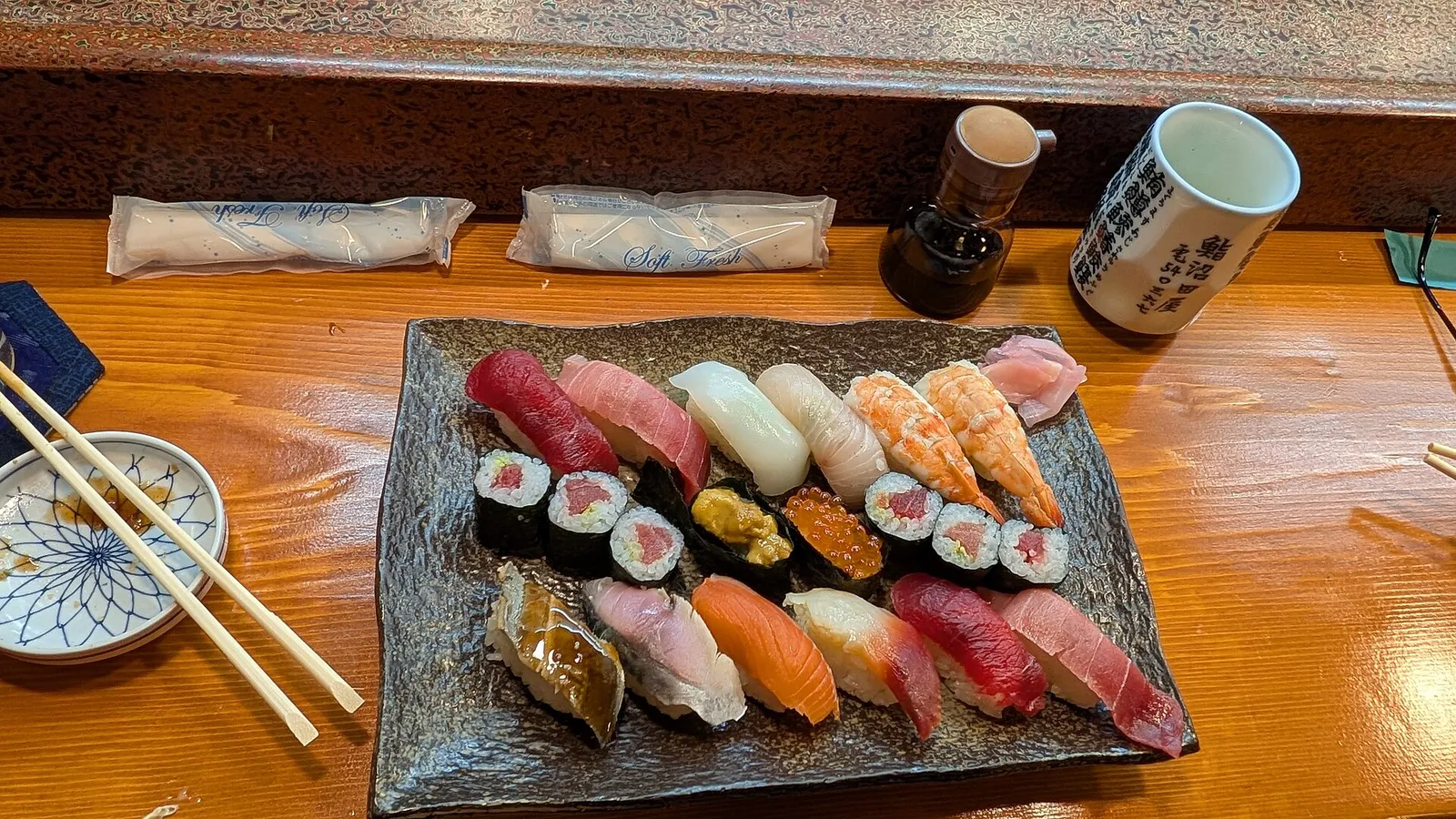
The step up is the counter: an Edomae-style sushi-ya where the chef forms each nigiri the moment you order it. Sushi restaurants in Japan span ¥1,000-30,000 per person, with neighborhood counters in the low thousands and top omakase counters in the tens of thousands. High-end counters seat as few as eight people and reservations are essential, often weeks ahead. Etiquette that actually matters: dip the fish side (not the rice) in soy sauce, use fingers or chopsticks — both are fine, never pass food chopstick-to-chopstick, and eat the gari (ginger) between pieces, not on top. A solid action plan for your first night: search Google Maps for a kaitenzushi chain near your hotel, watch one full rotation before grabbing anything, and save the counter splurge for later in the trip.
Ramen, Ticket Machines, and the Ichiran Model
Ramen shops are engineered for speed and solo diners, and many still run on the meal-ticket system: buy a ticket from the vending machine at the entrance (photos, English buttons on many machines in tourist areas), hand it to staff or place it on the counter, and sit. If the machine defeats you, most have an English help option or you can pull a staff member to the machine — pointing at a photo with a sheepish “sumimasen” works universally. Bowls cost roughly ¥500-1,500 at standard shops, with trendy city shops pushing higher; add gyoza as a set for a small discount.
Chains like Ichiran — famous for solo “flavor concentration” booths where you order via a customization sheet and a privacy flap between you and the staff — take the low-interaction model to its logical extreme, and they are an easy first ramen for exactly that reason. Expect a line at peak hours; the queue at Ichiran-style shops typically starts at the ticket machine. Regional styles are worth chasing: miso in Sapporo, tonkotsu in Fukuoka (Ichiran’s base style), shoyu in Tokyo. Slurping is normal and encouraged — it cools the noodles and is read as enjoyment, not rudeness. Eat fast: noodles sit in broth and go soft.
Izakaya and the Otoshi You Didn’t Order
An izakaya is a pub that serves food — small shared dishes, a few hundred yen each, ordered round by round over a couple of hours, with a total of ¥2,000-5,000 per person. Here is the part that generates a shocking number of confused TripAdvisor posts: shortly after you sit down, a small dish you did not order arrives. That is the otoshi, served in lieu of a seating charge, and it costs a few hundred yen per person. It goes on the bill automatically. It is not a scam, not a mistake, and not optional — treat it as your cover charge and eat it.
Ordering is increasingly painless: many izakaya now use touch-panel tablets at the table, usually with English menus, and the pattern of “order a few things, drink, repeat” replaces the Western one-shot order. All-you-can-drink (nomihodai) plans start around ¥2,000 for 90-120 minutes and often beat ordering drinks individually — but they usually start on a timer when the first drink arrives, so order it when the food does. On busy weekend evenings some places impose a roughly two-hour table limit. The bill: take the tab or table token left at your table to the register near the exit — staff will not bring it to you.
Teishoku, Donburi, and Wagyu Without the Wallet Damage
For everyday eating, two formats dominate. Teishoku (set meals) — a main plus rice, miso soup, and pickles — run ¥1,000-2,000 and are the standard business-district lunch. Donburi (rice bowls) are faster and cheaper: gyudon (beef bowl) chains serve full meals for ¥500-1,000 and are open late or 24 hours. For context, soba and udon shops run ¥500-1,500, curry shops ¥500-1,500, and family restaurants ¥1,000-2,000 — this is the ¥800-3,000 real world of Japanese eating out, where ¥1,500 buys something genuinely good.
Wagyu deserves a budget decision before you walk in. Yakiniku (Korean-style grilled beef) restaurants span ¥1,500-7,500 per person: the low end is a casual lunch set of standard cuts, the high end is premium wagyu by the gram. The pragmatic move: try a mid-range yakiniku dinner where you grill at the table and order plates incrementally — you control the spend plate by plate. Two cheaper wagyu hacks: supermarket sushi platters land under ¥600, and department-store basement food halls (depachika) sell graded wagyu bento at a fraction of restaurant prices, though premium-level wagyu still costs real money anywhere. Check menu prices posted at the entrance — Japanese restaurants almost always display them outside, so nothing is a surprise.
Breakfast: The Honest Picture
Western hotel breakfast in Japan is decent and expensive (often ¥2,000-3,500 if not included); business hotels rarely include it. The local reality is more interesting. Many kissaten — old-school coffee shops, meals around ¥500-2,000 — run a “morning set”: order a coffee and a simple toast-and-egg plate comes with it or costs barely more; in Nagoya and the surrounding region this morning culture is practically an institution. The third option is the convenience store: onigiri (rice balls), sandwiches, and bakery items mostly under ¥500, eaten at the counter or on a bench — a completely normal Japanese breakfast, not a defeat. If your hotel has free breakfast, take it; otherwise alternate kissaten mornings with konbini picnics.
Dietary Restrictions and Allergies
Vegetarian and vegan eating in Japan is genuinely harder than in most Western countries, and the reason is invisible: dashi stock and bonito fish flakes are foundational seasonings, so a dish that contains no visible meat is not necessarily vegetarian. The word “vegetarian” itself is understood loosely — asking for a vegetarian meal may still land you chicken broth. The reliable strategies, per JNTO’s own vegetarian guide: be explicitly specific (no meat, no seafood, no fish stock, no chicken, no pork), carry a printed explanation in Japanese to show staff, lean on shojin ryori (Buddhist temple cuisine, traditionally fully plant-based), look for certification stickers from the Japan Vegan Society or VegeProject Japan, and use the HappyCow or Vegewel apps to find suitable restaurants in cities. Convenience stores have reliable fallbacks: umeboshi or kombu onigiri, edamame, inarizushi, salads — check the label, since even natto packs can contain dashi-based sauce.
Allergies work the same way: spoken English does not survive the trip from table to kitchen, written Japanese does. Prepare before you fly — open our dietary restrictions communication card on your phone, screenshot it large, and show it while ordering. Say the severity, not just the allergen. For set-menu reservations and ryokan dinners, notify the restaurant when you book, not when you sit down; kitchens prep in advance and are far more accommodating with a day’s notice. When all systems fail, our restaurant ordering help card gets a server to the rescue.
Common Mistakes
- Waiting for the bill. Nobody will bring it. Say “okaikei onegaishimasu” (check, please) or carry your tab to the register near the exit — this is the system, not neglect.
- Tipping. Don’t. It is not customary, causes genuine confusion, and staff may chase you down the street to return your money.
- Freaking out about the otoshi charge. It is a seating charge in appetizer form, a few hundred yen, universally applied. Eat it and move on.
- Buying your ticket after sitting down at a ramen shop. Machine first, then seat. If staff wave you back out the door, they are pointing you to the machine, not ejecting you.
- Assuming “vegetarian” means vegetarian. Dash-based stock is everywhere. Use written Japanese, temple cuisine, and HappyCow — see the strategies above.
- Expecting restaurant Japanese review scores to work like Yelp. Tabelog, the dominant local review site, scores on a harsher curve; a 3.5 there is already very good (general observation, treat as a rule of thumb).
- Budgeting like it is Europe. Between ¥500 gyudon and ¥3,000 teishoku, most travelers average ¥1,500-2,500 per restaurant meal. If you are spending more, you are choosing to — which is also a perfectly good Japan strategy.
See it in motion
Some places earn a moving picture
Stills can't show how this place moves — the drift, the light show, the crowd flow. We picked a recent, high-quality walkthrough rather than a promotional cut.
Watch THIS Before Eating Sushi in Japan 🍣 (Beginner’s Guide!)
PiQtour Japan · YouTube · plays on click
Embedded via YouTube's official player (privacy-enhanced mode). Video: Watch THIS Before Eating Sushi in Japan 🍣 (Beginner’s Guide!) by PiQtour Japan. Not affiliated with Japan Travel Navi; screened for quality and accuracy on 2026-10-06.
Sources & verification (7)
- https://www.japan-guide.com/e/e2040.html
- https://www.japan-guide.com/e/e2036.html
- https://www.japan-guide.com/e/e2036_izakaya.html
- https://www.japan-guide.com/e/e2042.html
- https://www.japan.travel/en/guide/sushi-in-japan/
- https://www.japan.travel/en/guide/vegetarian-guide/
- https://www.japan.travel/en/gastronomy/local-street-food-favorites-budget-restaurant-japan/