Hiking Japan: From Fuji Summits to Pilgrim Trails
Japan is one of the most hiker-friendly countries you will ever visit: mountain trails start where the bus stops, mountain huts sell dinner and a futon, and routes run from an easy post-town stroll to the 3,776-meter summit of Mount Fuji. This guide ranks the four classic hikes by difficulty — the Magome-to-Tsumago Nakasendo walk for beginners, the car-free valley of Kamikochi, the multi-day Kumano Kodo pilgrimage, and the Fuji climb with its July-to-September season, mandatory fees, hut reservations and gear checks — plus bear-smart habits and hut etiquette. Season dates and fees as of October 2026.
The short version
- Climb Fuji only in the official season: the Yoshida trail is open roughly July 1 to September 10, and every trail charges a ¥4,000 admission fee paid online in advance
- Fuji's Yoshida trail now caps entries at 4,000 hikers a day and bans 'bullet climbing' — you must have a mountain hut reservation to start in the afternoon-to-dawn window
- Start with the Magome-Tsumago walk (8 km, 2-3 hours, luggage forwarding ¥1,000 per bag) — the gentlest historic hike in the country
- Kamikochi is car-free (April 17-November 15): you reach the trailheads by bus, and the riverside walks require no hiking experience at all
- Walked the Camino de Santiago? Complete the Kumano Kodo and claim the free Dual Pilgrim certificate in Tanabe or at Kumano Hongu
Japan is a volcanic archipelago the size of California with 70 percent of its land covered in mountains, and the hiking culture to match. What makes it unusually easy for visitors: trailheads sit at the end of regular bus lines, mountain huts feed and bed you at 3,000 meters, and the four classic routes below scale cleanly from “anyone in sneakers” to “the summit of Fuji.” Pick your level, book what needs booking, and go.
Which Hike Matches Your Ambition
| Hike | Difficulty | Time needed | Best season |
|---|---|---|---|
| Nakasendo: Magome to Tsumago | Easy | 2-3 hours (day trip) | Year-round (avoid deep snow, Jan-Feb) |
| Kamikochi valley walks | Easy | 1-6 hours | April 17 - November 15 |
| Kumano Kodo Nakahechi route | Moderate | 2-4 days | March-November |
| Mount Fuji (Yoshida trail) | Strenuous | 2 days / 1 night | Early July - early September |
Work up the table, not down it. Each rung teaches you the habits — cash for huts, layered clothing, early starts — the next one assumes.
Mount Fuji: Book a Hut, Then Climb at Night
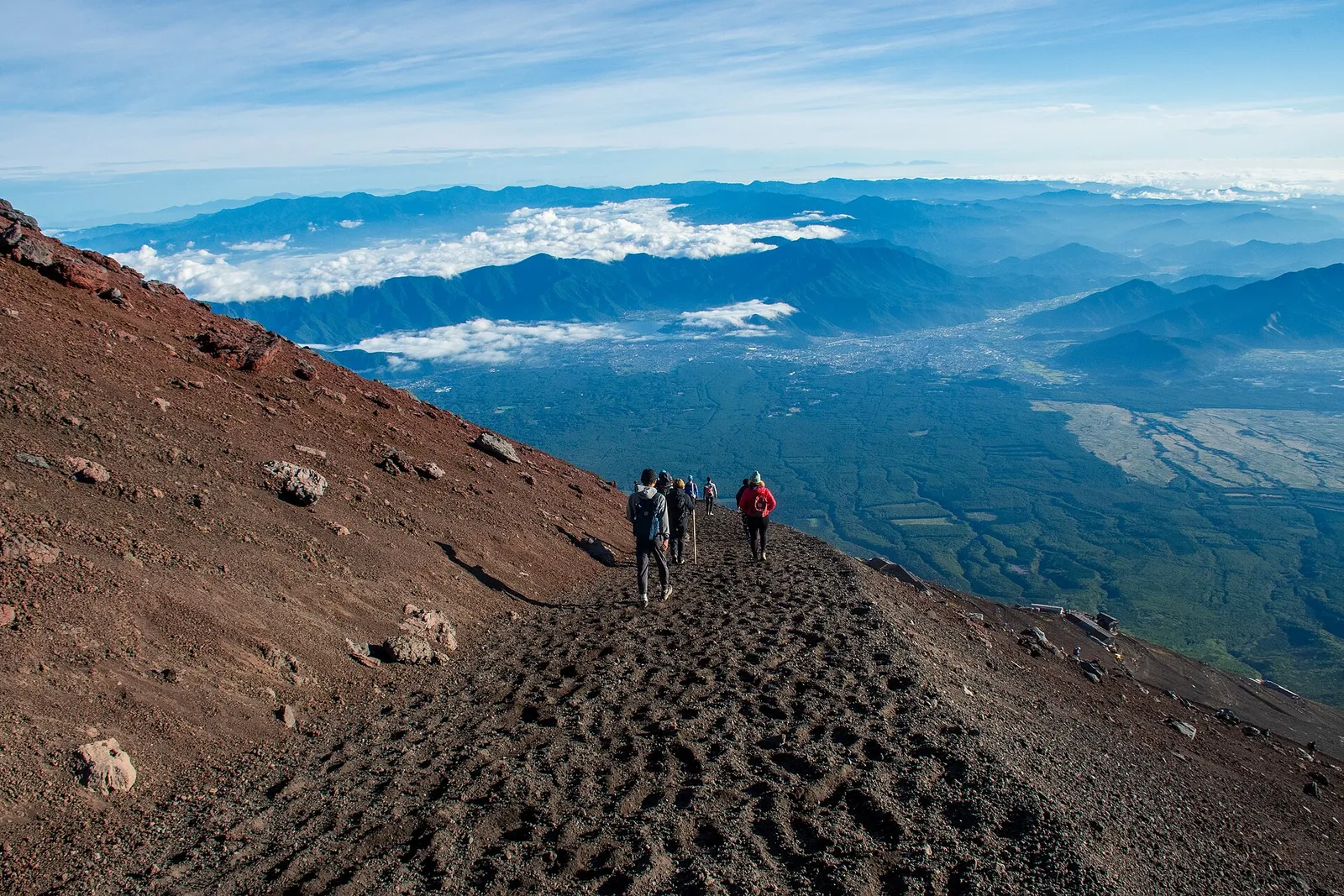
Fuji is climbed only in the official summer season, and 2026’s ran much like every recent year: the Yoshida trail from the Fuji Subaru Line 5th Station (altitude about 2,300 m) opens around July 1, the three Shizuoka-side trails around July 10, and all close September 10 — the mountain is legally closed to climbing above the 5th stations outside the season, and for good reason: off-season Fuji claims lives most years.
The standard plan is two days: bus up to the 5th station in the afternoon, sleep at a hut around the 7th or 8th station, then wake around 2 a.m. and summit for sunrise (roughly 4:30-5:00 a.m.). Ascent takes 5-7 hours, descent 3-5 hours on scree. The rules tightened recently, and as of October 2026 you need to plan around:
- ¥4,000 admission fee on every trail, paid online in advance (same-day purchase is possible at the trailhead, but do not rely on it).
- A daily cap of 4,000 hikers on the Yoshida trail — reserved online, it has not sold out yet, but book before you fly.
- No bullet climbing: Yoshida trailhead gates are closed 2 p.m. to 3 a.m. except for hikers holding mountain hut reservations. Climbing straight through the night without sleep is banned for altitude-sickness reasons, and huts will not let you nap without a booking anyway.
- Mandatory gear checks at the Yoshida trailhead: proper trekking shoes, cold-weather clothing and rainwear. Turn up in sneakers and a hoodie and you will be turned back.
Mountain huts cost ¥13,000-15,000 per person with two meals (as of October 2026) and should be reserved weeks ahead for weekends — through the official hut-booking sites linked from fujisan-climb.jp (the Yoshida route has a dedicated reservation portal; many huts have little or no English, so book the moment your dates are fixed). Toilets along the trail and at the summit charge ¥200-300 and want exact coins, and most huts sell water, food and canned oxygen at mountain prices — carry ¥10,000+ in cash per person.
Altitude is the real summit fee. You sleep at 3,000+ meters having climbed from 2,300, and mild altitude sickness (headache, nausea) is common. Action plan: spend an hour acclimatizing at the 5th station before starting, climb slowly, drink water steadily, and if symptoms worsen, descend — it is the only cure. Buses from Kawaguchiko Station reach the 5th station in 50 minutes (¥2,000 one way, ¥3,400 round trip); direct buses from Shinjuku take 150 minutes (¥4,800).
Kumano Kodo: The Two- to Four-Day Pilgrimage
The Nakahechi route through the Kii Peninsula is Japan’s Camino de Santiago — a UNESCO-listed network of emperor-worthy trails between spa towns and grand shrines, walkable from mid-March through November. The classic stretch runs Takijiri-oji to Kumano Hongu Taisha, about 38 km, typically split over 2-4 days with nights in guesthouses and onsen towns like Yunomine and Kawayu (where you soak in a riverbed hot spring — bring the onsen guide etiquette).
Pick up a free pilgrim credential stamp booklet at the Tanabe or Shingu tourist information centers and collect the oji-shrine stamps as you walk; the completion stamp is at Kumano Hongu Taisha. And if you have ever walked at least the final 100 km of the Camino de Santiago (by foot or horse; 200 km by bike), you qualify as a Dual Pilgrim: show your Santiago proof and stamped Kumano credential at the Tanabe Tourist Information Center (9:00-18:00, next to JR Kii-Tanabe Station) or the Kumano Hongu Heritage Center (8:30-17:00), and receive a washi-paper certificate from the head priest plus a pin badge, in person only. As of late 2026 more than 17,600 people from 85 countries have done it.
Action plan: take the JR limited express from Osaka (via Tennoji) to Kii-Tanabe, then the local bus to Takijiri trailhead. Baggage transfer between accommodations — the difference between a pilgrimage and a death march — is arranged through the KUMANO TRAVEL booking site or your guesthouses; book lodgings two to three months ahead for spring and autumn.
Nakasendo: The Magome-Tsumago Starter Hike
If Fuji is the ambition, this is the tutorial. The old Nakasendo highway linked Edo (Tokyo) and Kyoto through the Kiso Valley, and its best-preserved section runs 8 km between the post towns of Magome and Tsumago: 2-3 hours on a well-maintained trail, marked in English and Japanese, crossing forest, fields and short asphalt stretches with a restored farmhouse serving tea at the halfway point. Walk Magome to Tsumago — slightly less uphill.
The moves that make it painless: leave your bag at the Magome or Tsumago tourist information center for luggage forwarding at ¥1,000 per piece (seasonal service, roughly March 20 through November: drop off 8:30-11:30, pick up 13:00-17:00), walk with a daypack, and return by the infrequent direct bus between the towns. From Nagoya, take the JR line to Nakatsugawa and the bus up to Magome (about 40 minutes), or aim for Nagiso Station on the Tsumago side. Extend to a full day by adding the Narai post town, the valley’s richest.
Kamikochi and the Alpine Step-Up
Kamikochi is the gateway to the Northern Japan Alps and a masterclass in Japanese mountain management: the entire valley is closed to private cars, open April 17 to November 15, and reachable only by bus or taxi — park at Hirayu Onsen or Sawando and ride the frequent shuttle in. From Takayama, take the hourly bus to Hirayu Onsen (60 minutes, ¥1,600) and change to the 25-minute Kamikochi bus (¥1,500 one way, ¥2,800 round trip); from Matsumoto, train to Shin-Shimashima then bus (about 90 minutes total, ¥3,810), or one of the few direct reserved buses. Our Takayama page folds Kamikochi into a broader Alpine route.
The valley-floor walks — Kappa Bridge, Taisho Pond, the Azusa River loop to Myojin Pond (admission ¥500) — are flat, boardwalk-friendly and need no hiking experience; that is where families stop. Fit hikers continue up the Dakesawa or toward the ridges, where the season shortens to roughly mid-June through mid-September. Monkeys raid unattended bags; bears are rarely encountered, but the same rules as everywhere in Japan apply (next section). One line for the serious: Hokkaido’s Daisetsuzan range is the big step beyond — genuine alpine terrain, brown bears instead of black bears, and a snow-shortened season of roughly July to September; go with a guide on your first visit.
Bears, Bells and Mountain Hut Manners
Bears: Japanese black bears live in most mountain forests on Honshu, Shikoku and Kyushu; Hokkaido has the larger brown bear. Encounters are rare on the busy classic routes, but the standard practice is cheap insurance: clip a bear bell to your pack (¥500-1,500 at trailhead shops) so you announce yourself, hike in daylight, never approach or feed animals, and make yourself big and loud — not frozen and quiet — if you do meet one. In brown-bear country like Daisetsuzan, follow your guide’s instructions exactly.
Mountain hut etiquette: huts are shelters, not hotels. Arrive by late afternoon, take off boots at the entrance, accept the fixed-time dinner and lights-out (usually around 20:00-21:00), sleep in shared rows of futons with strangers on both sides, and leave by mid-morning. Pay in cash, keep conversations low after lights-out, and never waste hut water — it is often trucked or melted. Lights-out is the friend, not the enemy: it puts you on the trail by 2:30 a.m. for a Fuji sunrise.
Gear: layers beat one big jacket (summit Fuji in August sits near 0°C at night with wind), rainwear is mandatory even on clear mornings, and headlamps plus spare batteries matter more than anything else you pack. Buy trekking poles at the 5th station shops if you must — but not in your home airport’s idea of “hiking shoes.”
Common Mistakes
- Climbing Fuji out of season or “just for the view.” The trails above the 5th stations are legally closed outside July-early September; sudden storms and snow kill unprepared climbers. Book within the season, full stop.
- Starting Fuji in the afternoon without a hut booking. The Yoshida gate closes 2 p.m.-3 a.m. to everyone except hut guests — bullet climbing is banned. No booking, no summit.
- Showing up in sneakers and a cotton hoodie. Yoshida’s mandatory gear check (trekking shoes, cold-weather layers, rainwear) will turn you away, and it exists because the weather above 3,000 m turns lethal in minutes.
- Assuming cards work on the mountain. Hut balances, ¥200-300 toilets, water and canned oxygen are cash. Withdraw in town the day before.
- Rushing altitude. Headache plus nausea at the 8th station means descend, not push. Acclimatize at the 5th station, hydrate, and let slow hikers summit at their own sunrise pace.
- Carrying all your luggage on the Magome-Tsumago walk. Use the ¥1,000 forwarding service and enjoy the forest instead of your shoulder straps.
- Driving to Kamikochi. Private cars are banned year-round; the lot you are heading for is a shuttle transfer, not the valley. Plan the bus chain from Hirayu Onsen or Sawando — or from Takayama or Matsumoto — in advance.
- Feeding or chasing wildlife for photos. The monkeys at Kamikochi and the deer at Nara are wild; food in open bags is an invitation, and a bear fed is a bear destroyed. Zip the pack, take the shot from distance.