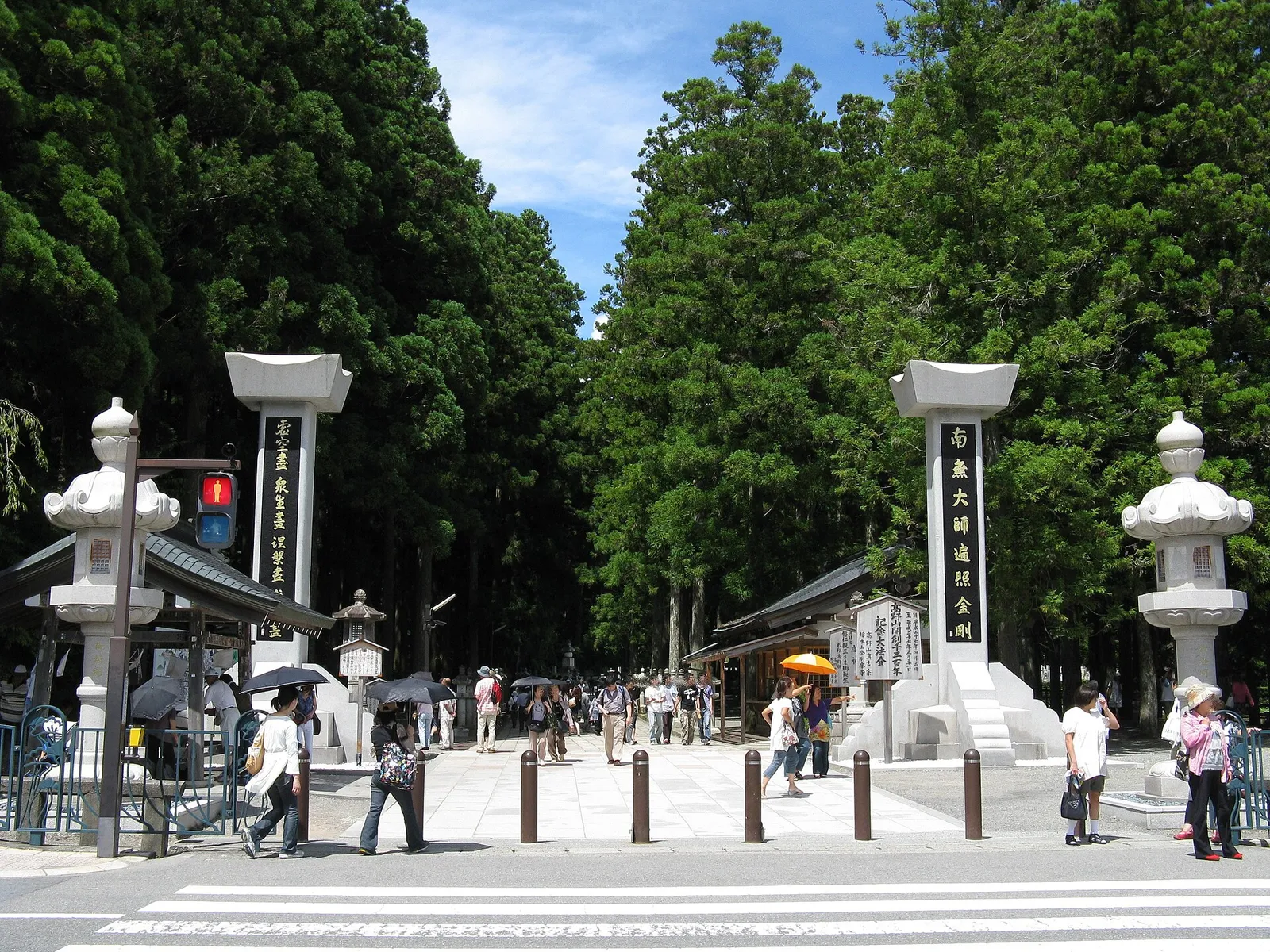
Koyasan (Mount Koya) is the headquarters of Shingon, Japan's esoteric Buddhist sect, founded by the monk Kobo Daishi in 816 on a forested plateau about 800 meters up in Wakayama's mountains. Around a hundred temples stand there today, and some fifty of them take overnight guests — the shukubo temple stay, with Buddhist vegetarian cuisine and a 6 a.m. prayer service, is one of Japan's definitive travel experiences. The sights are extraordinary too: Okunoin, the vast cedar-shaded cemetery where Kobo Daishi is believed to rest in eternal meditation, and the Garan, whose great vermilion pagoda anchors a ritual complex at the town's heart. Koyasan suits travelers who want depth over checklists. Two hours from Osaka, give it a night — a day trip wastes the best hours.
Top sights at a glance
No. 1
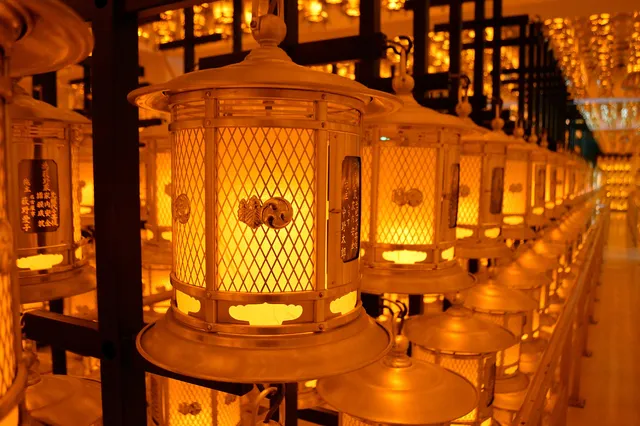
Okunoin Cemetery
Japan's largest cemetery: over 200,000 moss-covered tombstones, memorial stones, and company monuments lining an almost two-kilometer approach through towering cedar, from Ichinohashi Bridge to the Gobyo, the mausoleum of Kobo Daishi — who, per Shingon belief, did not die in 835 but rests in eternal meditation, awaiting the Buddha of the Future. At the far end, the Torodo lantern hall keeps more than 10,000 lamps eternally lit. Daimyo, popes of commerce, and airlines bought plots here for 1,200 years; the walk is one of the great cemetery landscapes on earth.
Good to know · Free, always open; the Torodo hall keeps 6:00-17:00. Bow at both bridges, and past Gobyobashi photography, food, and drink are forbidden — the rule is enforced. Walk in from Ichinohashi (10-15 minutes from town, or a ¥160 bus) for the full approach; go at night with a flashlight, or on a guided evening tour, for the full effect.
No. 2
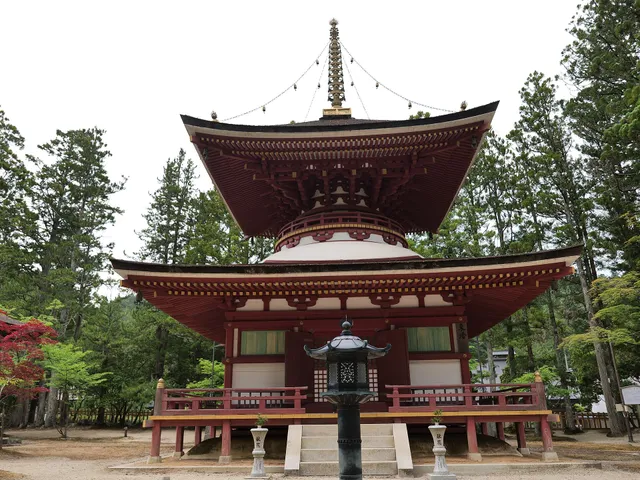
Danjo Garan
The ritual heart Kobo Daishi laid out himself: a compound of halls and twin pagodas around a pine tree — the sankosho legend says his ritual vajra, thrown from China, landed in it. The Konpon Daito, a vermilion 45-meter pagoda, encloses a rare three-dimensional mandala of cosmic Buddha statues, and the Kondo main hall hosts the sect's major ceremonies. Come early or at dusk, when the halls are quiet and the light comes sideways through the cedars, and the compound lives up to the word 'sacred' without irony.
Good to know · Grounds free and always open; Kondo and Daito each ¥500, 8:30-17:00, as of October 2026 — or covered by the ¥2,500 common ticket with Kongobuji and the Reihokan Museum. Five minutes on foot from the Senjuinbashi intersection, the town center. Combine with Kongobuji next door in one circuit.
No. 3
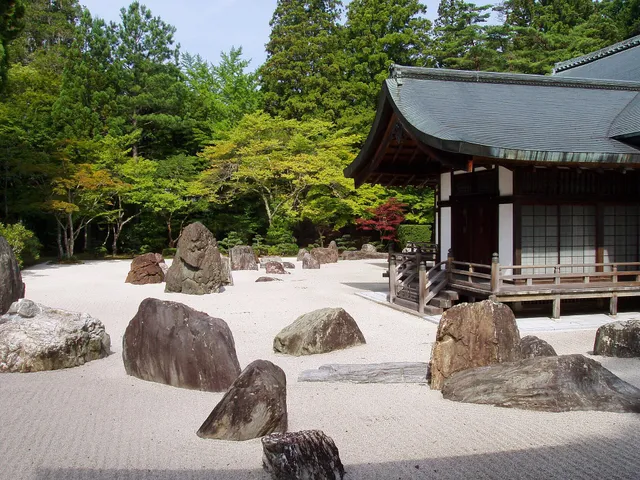
Kongobuji Temple
The administrative head monastery of Shingon Buddhism, founded by Toyotomi Hideyoshi in 1593 as a memorial temple for his mother. The drawn pleasures are interior: gold-leafed audience rooms with Kano-school crane paintings, the Willow Room where Hideyoshi's heir was ordered to die, and the Banryutei rock garden — Japan's largest, two granite dragons in a sea of raked gravel. The ticket includes tea and a cookie in a tatami room, which is exactly the right pace for this building.
Good to know · ¥1,000, open 8:30-17:00 (entry until 16:30), no closing days, as of October 2026; the ¥2,500 combination ticket adds the Garan halls and Reihokan Museum. Photography is restricted in most rooms — the rock garden is the one to shoot. Five minutes from Senjuinbashi, next to the Garan.
No. 4
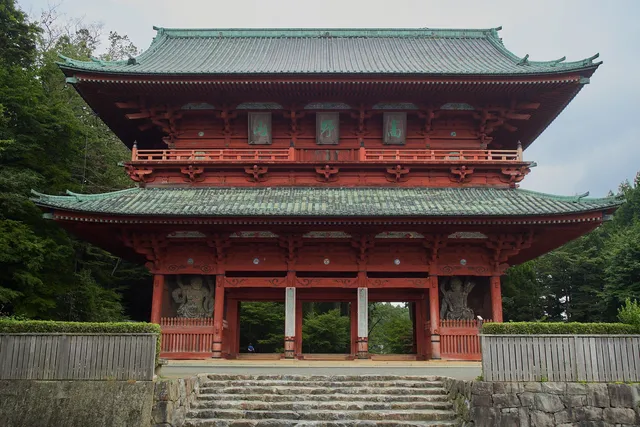
The Daimon Gate
The mountain's front door: a huge two-story wooden gate at the western edge of the plateau, flanked by a pair of ferociously muscular Nio guardian statues and facing a long view over the forested valley — on clear winter days, all the way to the Seto Inland Sea. Rebuilt repeatedly after fires over the centuries, it still does what a great gate does: makes you slow down on the way through. Most day-trippers never reach it, which is reason enough to go.
Good to know · Free and always viewable; 15-20 minutes on foot west of the Garan — the road is flat and the walk is the point. Sunset from the platform in front is the local classic; bring a layer, the plateau runs cold after dusk even in autumn.
No. 5
A Temple Stay (Shukubo)
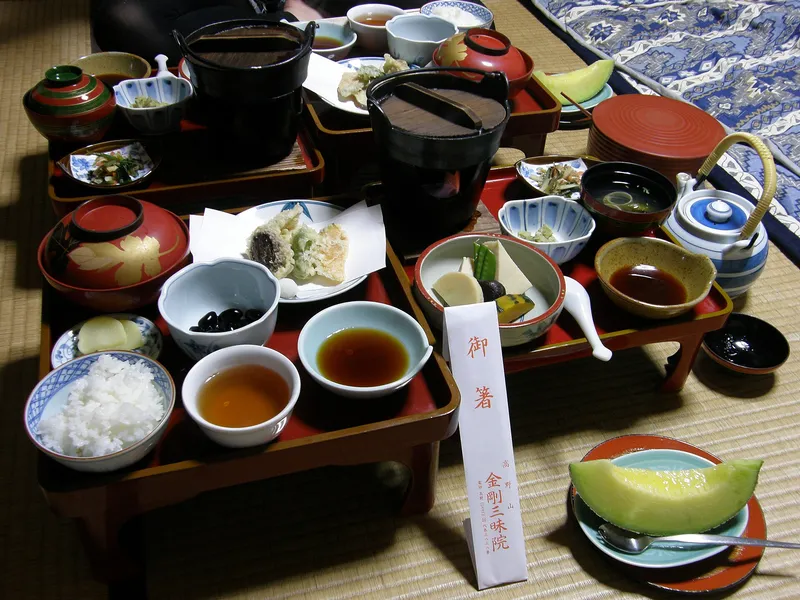
Some fifty of Koyasan's temples run shukubo — lodging for pilgrims that doubles as Japan's most atmospheric hotel category: tatami rooms, futons, shared baths, and two meals of shojin ryori, the vegetarian cuisine Buddhist kitchens developed over twelve centuries (the sesame tofu here is the benchmark version). The experience that makes it: the morning service, around 6:00, when the halls fill with chant, incense, and often a goma fire ritual — cedar stakes burned for prayers — before a quiet breakfast. You sleep in a working monastery, and it works.
Good to know · Roughly ¥10,000-40,000 per person with dinner and breakfast; most temples take only cash, as of October 2026. Arrive by 17:00 for check-in and dinner (17:30-18:00), lights out early, morning service ~6:00 (30-45 minutes) — then breakfast and the empty morning town. Book two or three months ahead for autumn foliage and book through the Koyasan tourist association's site or a booking platform with temple lists.
See it in motion
Some places earn a moving picture
Stills can't show how this place moves — the drift, the light show, the crowd flow. We picked a recent, high-quality walkthrough rather than a promotional cut.
Early Morning Walk along Okunoin Forest Path | Koyasan, Japan 4K
Ambient Exploration · YouTube · plays on click
Embedded via YouTube's official player (privacy-enhanced mode). Video: Early Morning Walk along Okunoin Forest Path | Koyasan, Japan 4K by Ambient Exploration. Not affiliated with Japan Travel Navi; screened for quality and accuracy on 2026-10-06.
Some destinations you visit; Koyasan you attend. The morning starts with sutra chanting and the smell of cedar smoke, breakfast is tofu in three forms, and the evening ends under cedar trees older than most countries — all on a flattened mountaintop two hours from Osaka’s neon. This is the headquarters of Shingon, the esoteric Buddhism Kobo Daishi brought from Tang China in 805, and it has been a working monastery town for twelve centuries: temples instead of skyscrapers, monks instead of commuters, and, since the pilgrim inns opened to foreigners, one of the most profound overnight experiences in Japan. Come for a night, minimum. The day-trip version sees the stones but misses the point.
A Bit of History
In 816, Kobo Daishi — Kukai, the monk who introduced Shingon Buddhism to Japan — received imperial permission to build a monastic center in the mountains south of Nara, and chose this eight-hundred-meter basin, by legend guided by a vajra he had thrown toward Japan from China and found lodged in a pine (the tree still stands in the Garan). Construction of the Garan complex began around 826 and outlived him; when Kukai died in 835, he was entombed to the east of the complex, and the cemetery that grew around his mausoleum — Okunoin — became the destination: believers hold that he rests not dead but in eternal meditation, awaiting the future Buddha, and that a visit is therefore a meeting, not a memorial.
What followed was medieval Japan’s great monastery city: at its height a town of thousands of monks’ quarters, temple colleges, and pilgrims’ lodgings, patronized by emperors and warlords who built memorial chapels for themselves and their clans — hence the Tokugawa mausoleum among the sights. The town had a full complement of temples, tea houses, and a particular rule of its own: women were barred from the sacred precinct until 1872 and worshipped instead at halls set around the mountain’s rim, the Nyonin-do. (One of those halls survives today, and the tradition is the reason Koyasan’s pilgrimage trails still carry their particular history.)
Kongobuji, the current head temple, dates to 1593, when Toyotomi Hideyoshi built it as a memorial for his mother; the name, “Diamond Peak Temple,” became the sect’s headquarters title in the 19th century, and today the mountain holds over a hundred temples, about fifty of which accept overnight guests. In 2004 UNESCO listed Koyasan within the “Sacred Sites and Pilgrimage Routes in the Kii Mountain Range,” alongside the Kumano Kodo — the two ends, in effect, of Japan’s sacred geography, linked by walking trails you can still take.
Culture & Daily Life
Koyasan is small — one main street, a few crossroads — and monastic. Monks in formal robes ride the local bus; the town’s calendar is the ritual calendar, from daily morning services at each temple to fire ceremonies and seasonal observances; and shops sell sutra scrolls, incense, and pilgrim gear alongside ordinary groceries. The rhythm imposed on visitors is the town’s own: temples close their doors around 17:00-17:30, dinner is early, and the day’s business concludes with a night walk or an early bed. Fighting the schedule is pointless; adapting to it is the attraction.
The etiquette matches. At Okunoin’s inner gates you bow; past Gobyobashi bridge, photography, eating, and drinking are prohibited (a rule actively enforced by staff). In temple lodging you remove shoes at entry, keep voices down in the corridors, observe bath hours (gender-separated communal baths — our onsen guide covers the drill at /guides/onsen-guide/), and treat the morning service as participation rather than performance: sit, stand, and chant as you are able, or simply observe quietly. No one will press you; everyone will notice if you are scrolling.
A note on seasonality: autumn (late October to mid-November) is the foliage peak and books out earliest; winter is silent and deep-snowed, with the lantern hall and cedar cemetery at their most atmospheric and the cable car line occasionally slowed by weather; summer runs ten degrees cooler than Osaka, which the monks have appreciated for twelve centuries. Whichever season, pack a layer — the plateau is cool at night year-round.
Nature & Day Trips
Koyasan is a bowl of forest at altitude: cedar and cypress cover the slopes, the town’s edges dissolve into temple compounds and trailheads, and the air smells of resin and incense smoke. The classic walk is the Choishimichi, the 22-kilometer pilgrim trail from Kudoyama station up to the Daimon gate, marked every few hundred meters by stone markers shaped like the vajra — a serious but glorious day’s hike that reenacts the historical approach (most of today’s visitors arrive by cable car instead; see below).
Two hours away by train, Osaka makes the obvious contrast and pairing (/destinations/osaka/), and Kyoto, the other pole of Japanese Buddhism, is about three hours door to door (/destinations/kyoto/). Southward, the Kumano Kodo pilgrimage network and its grand shrines extend the sacred-geography theme; our temple-focused Kansai itinerary strings Koyasan with Kyoto, Nara, and Mount Koya’s own trails (/itineraries/temple-trail-kansai/). Within the town itself, “nature” is the cemetery cedars, the forest paths between the Garan and Okunoin, and the viewing platform at the Daimon — enough green for anyone’s day off from cities.
Food & Drink
The food here is shojin ryori, the vegetarian temple cuisine that Buddhist kitchens refined over centuries under rules against killing — and Koyasan is its home ground. Dinner at a shukubo arrives as a procession of small dishes: sesame tofu (goma dofu, the local signature, custard-firm and nutty), koya-dofu (freeze-dried tofu, said to have been invented here by monks leaving tofu out on winter nights), seasonal mountain vegetables, miso-glazed dishes, tempura, and rice with millet. Breakfast is a gentler replay. It is quiet food, deliberate and subtly salted, and after a day of mountain air it is better than it sounds — vegans and vegetarians should note that dashi stock and the occasional egg-based dish vary by temple, so state your needs when booking: 「すみません、卵と乳製品は食べられません。ありがとうございます。」
The town itself has a scattering of restaurants serving shojin set meals at lunch (roughly ¥2,000-4,000), soba shops, curry houses, and convenience stores — monastic towns feed pilgrims of all budgets, and nobody enforces vegetarianism outside temple walls. If you want one restaurant meal, make it lunch between the Garan and Okunoin; save dinner for your temple, because the meal is half the reason you are staying in one. Alcohol is generally available at shukubo (some temples discourage it; beer or sake can usually be brought or ordered) — moderation is the polite line.
Top Sights
Okunoin Cemetery
Begin at Ichinohashi, the single-slab bridge at the cemetery’s entrance, and bow once across it. The two-kilometer path that follows is Japan’s most extraordinary walk through the dead: enormous cedars, moss thick as upholstery, and 200,000 monuments — daimyo armor carved in stone, spaceship-shaped corporate memorials for companies that wanted eternity nearby, cups and gasoline pumps for the addicted, all commissioned so that their owners might await the future Buddha near Kobo Daishi’s side. Water-poured Jizo statues and the one-handed Miroku stone (it is said to feel lighter to the good) punctuate the route.
Cross Gobyobashi — bow again; from here, no photos, food, or drink — into the inner sanctum: the Torodo lantern hall, its more than 10,000 lamps kept burning, some for nine centuries, with 50,000 small Buddha statues donated in 1984 lining the basement, and behind it the Gobyo mausoleum itself, where pilgrims chant. The whole approach takes 45 unhurried minutes each way; the Torodo hall is open 6:00-17:00, and the grounds are always open, as of October 2026. Night is the connoisseur’s hour — the lantern light, the cedar dark, the footsteps. Several temples and the tourist association run guided evening walks; with a flashlight and respect, you can also simply go.
Danjo Garan
The Garan is Koyasan’s ritual core and its architectural showpiece: a compound of halls, dining rooms, dormitories, and two pagodas organized around the sacred pine. Two buildings anchor it. The Konpon Daito — the great pagoda, 45 meters of vermilion, tahoto-style — contains a three-dimensional mandala: a cosmic Buddha surrounded by attendant deities arranged as a diagram you can stand inside, the entire point of Shingon’s esoteric iconography. The Kondo, the main hall, hosts the sect’s major ceremonies and has burned and been rebuilt many times (the current hall dates from 1932).
The grounds are free and always open; the Kondo and Daito interiors cost ¥500 each, 8:30-17:00, as of October 2026, or fall under the ¥2,500 common ticket with Kongobuji and the Reihokan Museum. Give it an unhurried hour — the compound rewards circling, from the founder’s Miedo hall to the Myojin shrine at the forest edge. The five-minute walk from Senjuinbashi, the town center, passes enough temples to slow anyone’s pace.
Kongobuji Temple
Kongobuji is the mountain’s seat of authority — the head monastery of Shingon — and its interiors show the sect at its most worldly-powerful: gold-leafed audience rooms, fusuma paintings by Kano Tanyu (the cranes of the Ohiroma room), the Willow Room where Toyotomi Hidetsugu was ordered to commit ritual suicide by his uncle Hideyoshi, and a kitchen with hearths sized for feeding thousands of monks. The 1984 Banryutei rock garden is Japan’s largest: 140 granite stones from Shikoku arranged as two dragons emerging from a sea of cloud, and the garden’s raked expanse is the building’s one wide-open view.
Admission is ¥1,000 and includes matcha and a sweet in a tatami room — sit, warm your hands on the bowl, and plan the rest of the day, as of October 2026. Photography inside is mostly prohibited; the rock garden and the corridor approaches are the frames to take. Twenty to forty minutes does it; pair with the Garan next door, and add the Reihokan Museum across the way if temple art is your language.
The Daimon Gate
The Daimon — “Great Gate” — is where the mountain has received visitors for twelve centuries: a two-story timber gate on the western rim, rebuilt again and again after fire and lightning, guarded by a pair of Nio deities of genuinely startling muscularity. Facing it, the view runs west down the forested valley toward the plain; on clear winter days it is said you can see the Seto Inland Sea. The gate anchors the historical pilgrim route — the Choishimichi trail ends here, climbing out of the valley directly in front of you.
Getting there is a flat 15-20 minute walk west from the Garan — most visitors stay in the center and never bother, which leaves it wonderfully uncrowded. Sunset is the local hour: the gate goes to silhouette, the valley fills with blue shadow, and the only company is likely to be a monk heading home. Free, always open, and cold after dusk; this is the plateau, not the plain.
A Temple Stay (Shukubo)
The shukubo is the experience that justifies the trip. Fifty-odd temples — from austere halls to grand compounds with gardens — open their guest rooms: tatami floors, futon beds, shared toilets, and big cedar baths; dinner and breakfast are shojin ryori, served early in your room or a dining hall; and the schedule is the temple’s, not yours. Check-in by around 17:00, dinner at 17:30-18:00, lights out when the gate closes; up before dawn for the morning service around 6:00 — thirty to forty-five minutes of chant and, at many temples, the goma fire ritual, in which a priest feeds cedar stakes to a roaring altar fire for the prayers written on them — then breakfast and a town that is, for one slow hour, entirely yours.
Prices run roughly ¥10,000-40,000 per person including both meals, as of October 2026; most temples accept only cash, so arrive with yen (see /guides/money-and-payments/). Book through the Koyasan tourist association’s English site, which lists member temples, or the booking platforms; for autumn foliage and any weekend, reserve two to three months out. Choose by character rather than price: temples near the Garan put you central; those along the road to Okunoin make the dawn walk to the cemetery absurdly easy; the grand ones with famous gardens reward splurgers. Whatever you choose, do not schedule a departure before 9:00 a.m. — you will want the morning service, and it would be a shame to sleep through the one alarm in Japan worth setting.
Getting There & Around
Koyasan belongs to the Nankai Railway, not JR — the Japan Rail Pass is no help here (see /guides/jr-pass-worth-it/ for the wider math). From Osaka’s Namba Station, take the Nankai Koya Line to Gokurakubashi at the mountain’s foot (about 100 minutes and ¥930 on express trains, most requiring a transfer at Hashimoto; limited expresses do it in 80 minutes for around ¥1,880 with an e-ticket), then the steep cable car up the last 5 minutes (¥500) and a 10-minute connecting bus into town (¥460) — about two hours and ¥1,890-2,990 door to door, as of October 2026. The Koyasan World Heritage Ticket (from ¥3,980) bundles the round trip with two days of unlimited town buses and sightseeing discounts; buy it at Namba.
Once up, the town is walkable — Garan to Kongobuji is five minutes, to the Daimon twenty — with buses (¥150-290 a ride, or a ¥1,500 day pass) saving time to Okunoin, whose entrance is a 20-25 minute walk or short ride from the center. Taxis meet the cable car for luggage-heavy arrivals; most shukubo will advise on the last sensible connection if you tell them your arrival time — and note that the last comfortable arrival is late afternoon, because dinner is at six and the mountain does not wait.
Where to Stay
The correct answer is “in a temple” — see the shukubo entry above for how it works, and note the two planning constraints: book early for foliage season and festival dates, and bring cash. Within that, the choice is character and location: temples clustered near the Senjuinbashi center and Garan make logistics easiest; those along the eastern road toward Okunoin trade convenience for a dawn cemetery at your doorstep; the famous grand temples with gardens and hierarchy reward travelers who want the full ceremonial dose. If every temple is full — it happens in November — the practical fallbacks are down the mountain in Hashimoto or along the Nankai line, at the cost of the evening and early morning that are the point.
For travelers who want a night of ordinary hotel comfort instead, Koyasan has a small number of conventional inns and business-style hotels around the center and station, and they serve a purpose: split a two-night stay into one temple night and one ordinary night if you sleep badly on futons. But do not skip the temple night entirely. Sleeping on a mountain of monks, eating their food, and standing half-awake in incense smoke at six in the morning is not a lodging category — it is the reason Koyasan is on your list.